


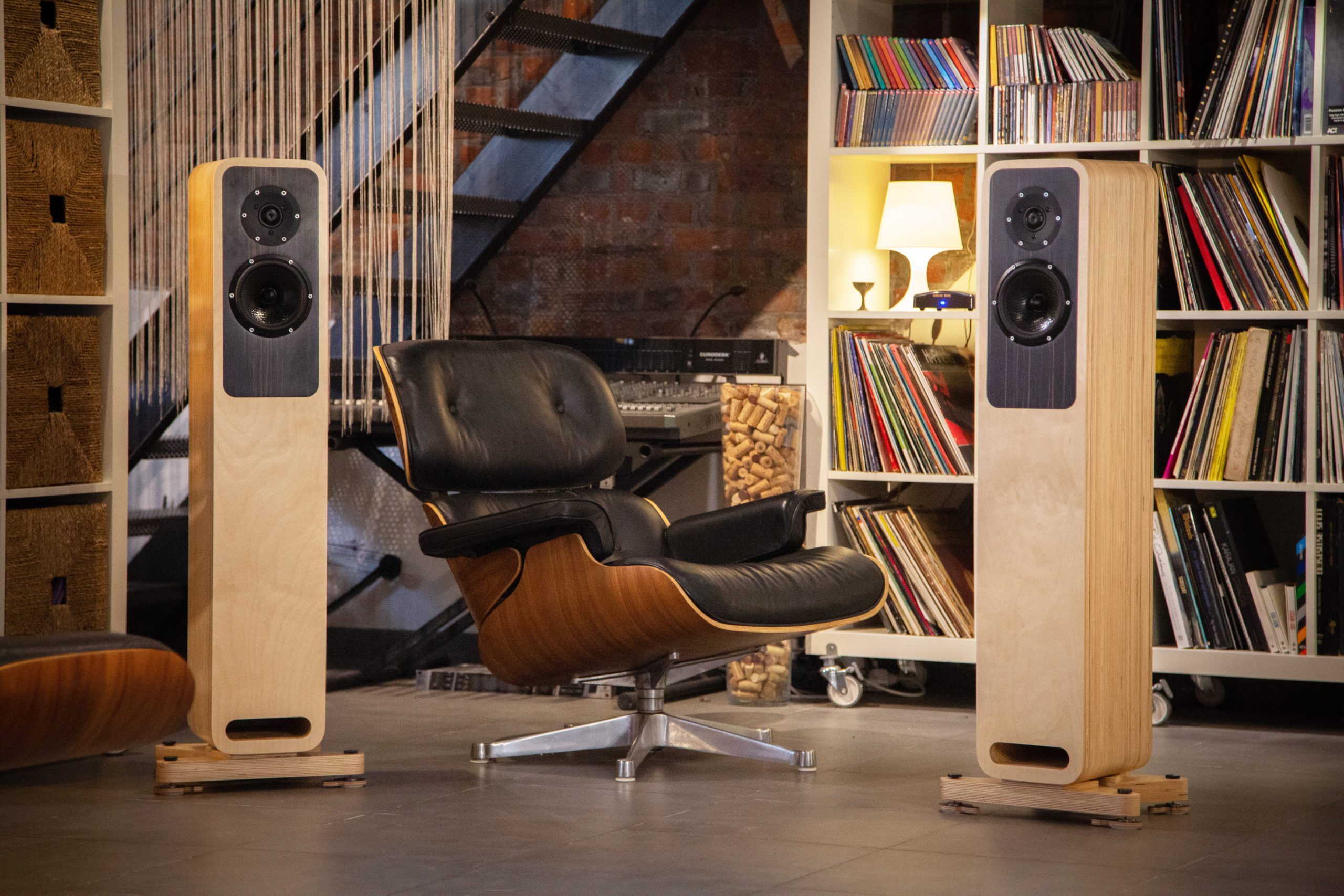
When the Malika Mk2 first arrived, there were no spikes in the box, which seemed odd, but I set them up and wondered why they appeared ill-equipped to cope with the tilt tests dealt out by EU regs. Only when the web site was checked did it become apparent that something had gone amiss in the Hi-Fi+ warehouse (see review stock dungeon), the two-part plywood bases that raise the speaker by 45mm and spread out the footprint for stability. These have unusually slim spikes in each corner and can be adjusted from above, which is handy, the c.4mm spikes being small enough to penetrate most carpets through to whatever lies beneath.
I started off driving the Malika Mk2 with an ATC P2, a power amplifier with a stiff 150W under the hood that can drive almost anything, including this speaker, which needed a bit more level than expected but nothing extreme. What first struck home was the quality of bass; the drive unit may not be massive, but the cabinet is unusually solid and devoid of plastic tubes. You can hear that in the low frequencies, which are more powerful and extended than expected. The Malika Mk2 can be placed about 50cm in the room and give a reasonably even balance but put it closer, around 20cm and things get more interesting. The bass doesn’t change as much as possible, but the imaging goes from so so to huge; it’s almost as if there are drivers in the back of the box, and the wall reflects their output. Of course, that is not the case; instead, it’s the nature of the box and the choice of drivers that works well in this position. It’s not a flat image either; there’s plenty of depth, and reverb is well served. On Irreversible Entanglements’ ‘Bread Out of Stone’ [Who Sent You? International Anthem], the double bass and drums seem to be physically present in the room, the male voice less so. Hence, but there’s no missing the power of its poetry. It’s a strong performance, no doubt.

Familiar tracks like ‘Fool-ology’ [Conjure, Music for the Texts of Ishmael Reed, American Clavé] are borderline revelatory when the image is spread this wide; it doesn’t mean too-large instruments and voices; instead, there is more space between them, which in turn means it’s easier to hear what’s going on. The degree of projection is not quite substantial, but this is probably because of the near-wall siting, which gives the best overall result I achieved. Tonally the Malika Mk2 is pretty even-handed, so much so that it’s a slightly tricky speaker to review; usually, there are characteristics good or less good that becomes clear after extended listening, but this didn’t prove to be the case here. Instead, they revealed every change made to the source and amplification that I tried with them. I had a McIntosh MA352 hybrid integrated driving them for a while, but the pairing didn’t gel, the sound became too forward and critical of recordings, only the best ones sounded good. So I switched to the Moor Amps Angel 6 and simply heard more, so that’s the way things stayed for the rest of the review.
This amp allowed a more elegant and revealing sound with real muscle in the bass; the tonal balance was best with the speakers toed out, e.g. with their axis passing either side of the listening position. Focusing the listener’s axis was not as relaxed or enjoyable, albeit the image precision was enhanced. Still, I preferred the mellower balance and enjoyed ‘So What’ from the evergreen Kind of Blue [Miles Davis, CBS]. The band is so together. The trumpet playing so nuanced that it sucked me in, especially when John Coltrane’s fabulous tenor comes in; this album was arguably the pinnacle of more than one career. With a Schubert orchestral piece, the Audel’s ability to throw up a large scale image came into its own. Rather, too many speakers tend to overwhelm with the power and dynamics of an orchestra; these present it with a realistic perspective. It’s 10th-row listening, not front row, and this allows the sound of the whole ensemble to merge in a meaningful way. By way of contrast, I tried Major Lazer’s ‘I’ll Make Ya’ [Guns Don’t Kill People… Lazers Do, Downtown], where the voice of Santigold whips up the beat to the point where things really start jumping, and the sound did indeed change gear and let the energy through in a clean, emphatic fashion.
Tags: FLOOR STANDING LOUDSPEAKERS
Trending Articles
See all
By Jason Kennedy
More articles from this author

Read Next From Review
See all
D’Agostino Audio Pendulum
- Jul 14, 2026

Meze Audio 105 AER
- Jul 14, 2026
REL T/9x SE
- Jul 14, 2026
Pro-Ject Speaker Box 5 E Carbon
- Jul 14, 2026