


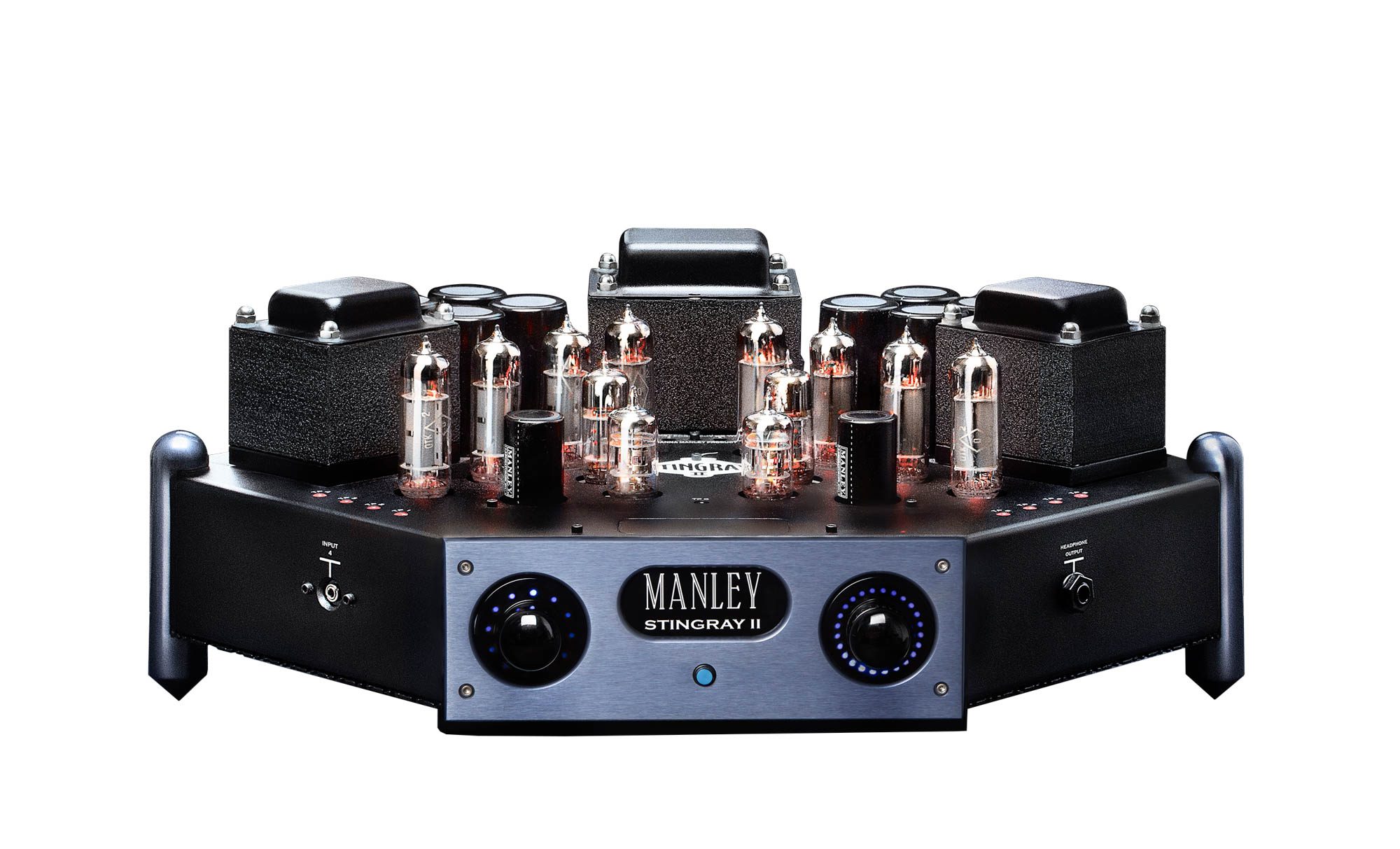
The history of hi-fi in movies is not a long one but there have been some notable examples; the Nakamichi cassette deck seductively spinning a tape on 9 ½ Weeks, the TEAC reel to reel that steals the scene in Pulp Fiction and – most recently – the appearance of a Manley Stingray II amplifier in Another Round, winner of the Best International feature film Oscar in April this year. It’s not hard to see why director Thomas Vinterberg would have chosen it, on style terms alone the Stingray is a distinctive piece of kit even before the glass starts to glow. I was struck by the way that the front of the amp, where the controls are, appears to be floating with the only visible legs being at either end of the diamond-shaped chassis. This is achieved by having the weight of the mains and output transformers at the back on the other two legs which counterbalances the front.

The Stingray II is an integrated amplifier with four EL84 output tubes per channel that can be run in triode or ultra-linear modes, the former specced at 20 Watts and the latter push-pull arrangement doubling the output. This tube is not found in many amplifiers today but made its name in one of the classic tube amplifiers of yore; the Leak Stereo 20 where a single pair of EL84s per channel delivered a sound that continues to charm listeners to this day. The Stingray II is more powerful and has a significantly wider range of features including inputs and outputs on the flanks either side of the controls. One of these is a minijack input for smartphones and computers and the other a 1/4” headphone jack. This last connects to the output from the output transformers and is a fine headphone amplifier, especially in triode mode.
A processor under the bonnet allows the Stingray II to be controlled remotely by either RF or IR commands, the walkie-talkie style handset can be run in either mode and allows operation from another room should the urge take you. Despite (or because of) its substantial size, this handset is quite nice to use, one of the few that’s designed for those with less than dainty digits, and if you look hard you’ll find most of the controls you need. Unlike many modern tube amps the Stingray II doesn’t have an auto bias system, instead there is a multi-meter and screwdriver in the box alongside clear instructions on how to set the current going through each tube. I gave this a go and found that the bias was close to the required 250mV on each, fine tweaking of each allowed it to be set precisely and quickly.
One of the quirks of the Stingray II chassis shape is that the socketry is on the back of either flank, which means that cables stick out at 45 degrees and those for left and right channels are quite far apart. If your interconnects aren’t attached to one another that’s not really a problem, but it does make for a more cable rich appearance that some might find an aesthetic challenge. There are three line inputs on RCA only alongside a record loop which effectively forms a fourth input and can be selected with the arcanely marked ‘insert’ button on the remote. The minijack on the front forms another input of course. The way this amp looks can be changed by altering the display which can be dimmed permanently or timed out after a specified duration, you can even select ‘starlight’ mode where you can choose how many of the LEDs twinkle “in a (mostly) random sequence”. Cool.
Trending Articles
See all
By Jason Kennedy
More articles from this author


Read Next From Review
See all
D’Agostino Audio Pendulum
- Jul 14, 2026

Meze Audio 105 AER
- Jul 14, 2026
REL T/9x SE
- Jul 14, 2026

Pro-Ject Speaker Box 5 E Carbon
- Jul 14, 2026