


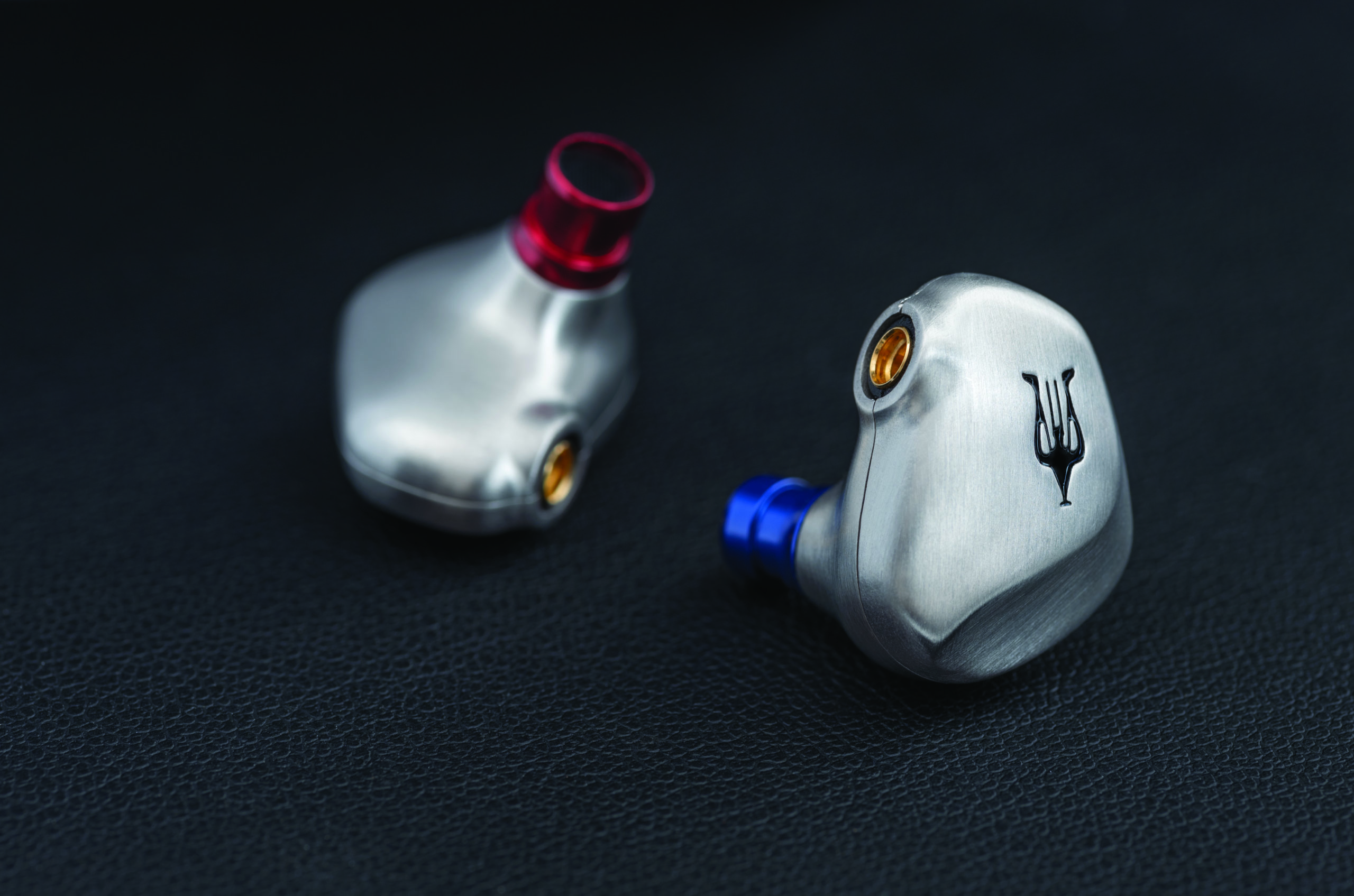
For all the thoroughness of the engineering that’s on display here, though, it’s on the inside that the RAI Solo are arguably at their most impressive. Meze Audio is vocal in its disdain for the common-or-garden electrodynamic driver with voice coil attached – it reckons this arrangement invariably results in unbalanced vibration. And, let’s be honest, it may well be on to something. So instead, Meze Audio takes a different approach: it uses an electrically conductive driver membrane which, consequently, has no wires attached. The idea is that this 9.2mm driver produces a symmetrical, unified pistonic motion which, in turn, promises extremely low total harmonic distortion.
Given that any worthwhile smartphone goes without a headphone socket (that’s the ‘mainstream’ for you), the Meze Audio RAI Solo are connected to a 128GB iPod Touch 7th Generation and a Naim Uniti Star (which for some inexplicable reason has a 3.5mm headphone socket rather than the altogether more serious 6.3mm alternative). Between them, they serve up audio from streaming services, from solid-state storage, from a Cambridge Audio Alva TT turntable and from a Cyrus CDt CD transport.

Every test has to start somewhere – and in an effort to leave all subsequent directions open, this test starts with a bog-standard Spotify-derived stream of The Fall’s Who Makes The Nazis? [Kamera]. It almost goes without saying that this recording is determinedly on the rough-and-ready side, but despite the gimpy rhythm and ruthlessly forward midrange, the RAI Solo have sufficient powers of resolution to bring a little order to bear. There’s a significant amount of background noise on this recording, but even when dealing with this 320kbps facsimile the Meze Audio are poised and detailed enough to make its origin apparent. Lesser in-ear monitors may just attempt to pass it off as tape hiss, but the RAI Solo make it apparent that rather than plugging directly into the desk, at least one of these musicians is playing into a mic’d amplifier – and an overdriven amplifier at that.
Elsewhere, midrange fidelity is sufficient to extract some perceptible meaning from the inimitable stream-of-consciousness ‘vocalising’ that was always Mark E Smith’s stock in trade. There’s even a degree of air around his voice, the suggestion of an area of security even as the ramshackle musical arrangement threatens to engulf him.
One grinding gear-change later and we’re listening to a 16bit/44.1kHz CD copy of Jackson Browne’s For a Dancer [Asylum]. There isn’t a pair of headphones in the world that wouldn’t be more at home with this material, and sure enough the relative lack of provocation gives the RAI Solo a chance to properly express themselves. Low frequencies prove deep (perhaps not the 18Hz deep Meze Audio is claiming, but deep nevertheless) and agile, with plenty of detail regarding texture revealed and nice straight edges leading into and out of individual notes. Integration with the rest of the frequency range is adept, yet bass information keeps a respectful distance from the midrange, which has plenty of room to stretch out as a result.
Browne doesn’t have the world’s strongest or most expressive voice, but there’s character in there and the RAI Solo do a fine job of revealing it. The finest details and subtle harmonic variations in pitch and timbre are all served up.
The top of the frequency range is given an even more thorough examination by a vinyl copy of Grouper’s AIA Alien Observer [Kranky]. This is a hazy, gauzy and altogether opiated album, but the Meze Audio freights treble sounds with ample substance and lets them glint through the drone. They stay properly defined around the edges, too, even when the overall sonic signature of the recording gets especially vague and amorphous. What attack is summoned through the course of the LP is given proper expression, and when it becomes stripped back to just multi-tracked harmony vocals (as it does on the almost-title track) there’s just enough bite to the upper register to offer proper drive.
In fact, the RAI Solo want for virtually nothing where drive and attack is concerned. An MQA file of The Comet Is Coming’s Summon the Fire [Impulse!] absolutely powers forward, grinding horns and squelching analogue synthesiser sounds to the fore. It’s a dynamic, wide-screen presentation with enough competing elements to pose a stern test – but the Meze Audio remain unarguably in charge. Their wide, deep soundstage is properly defined, and the dynamic peaks and troughs of the tune are tracked faithfully. No matter if it squeals from the back of the stage or honks from the front, the RAI Solo give it precisely the space and emphasis it requires.
Tags: IEM IN-EAR MONITOR MEZE AUDIO RAI SOLO
Trending Articles
See all
By Simon Lucas
More articles from this author

Read Next From Review
See all
D’Agostino Audio Pendulum
- Jul 14, 2026
Meze Audio 105 AER
- Jul 14, 2026
REL T/9x SE
- Jul 14, 2026
Pro-Ject Speaker Box 5 E Carbon
- Jul 14, 2026