


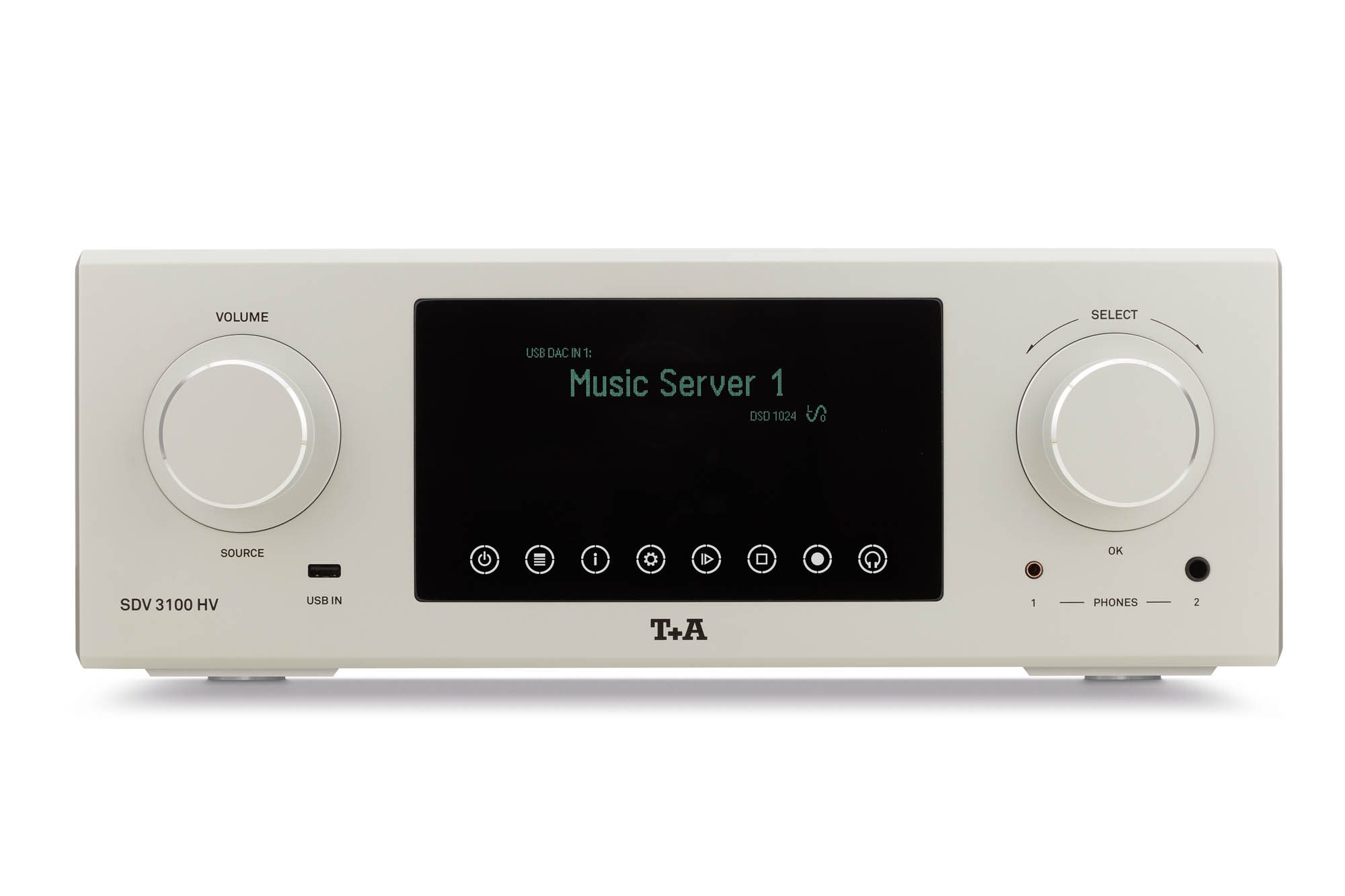
This review is all about space management. Not the physical size of the T+A SDV 3100 HV, or anything to do with room treatment. It’s just if I start listing what this DAC/preamplifier/headphone amp does in any degree of fine detail, you’ll be reading a 60-page review. There’s comprehensive… and then there’s the SDV 3100 HV. A large, expensive, technologically-advanced combination DAC and preamplifier (with a headphone amplifier option) is always going to be comprehensively specified, but even by those standards, the SDV 3100 HV is exceptional in the scope of its operation and connectivity. There is one omission (MQA), but even qualifying what the SDV 3100 HV does for a living gets long-winded simply because it does so many jobs; it’s technically a streaming digital converter and analogue/digital preamplifier with headphone amplifier. Going deeper still, the 3100 HV is a modular platform, as there is also a SD 3100 HV that omits the preamplifier circuitry.
The comprehensiveness of the headline features is impressive enough, but it’s the application of those headline features that really shows the company’s mettle. Given ‘application’ is baked into T+A at a fundamental level (‘T+A’ is short for ‘Theory + Application’, meaning the German T+A Electroakustik company set out its store from the outset as being thoroughly engineering and science-driven). This is a pinnacle project from a company that has a lot of digital engineering under its belt; the company’s engineering design department is larger than the whole team of many well-known high-end amp makers, and the brand’s lead designer, Lothar Weimann, has been with the company since 1978, joining T+A while still at university. Lothar and T+A have been working in the domestic digital audio field for as long as there has been domestic digital audio, and those decades of design skills are realised in the SDV 3100 HV, in terms of the comprehensive spec sheet, build quality, the seamless integration of soft- and hardware, and – of course – sound quality.
Let’s start with the hardware, in part because the SDV 3100 HV is such a physically significant device. Sitting larger and heavier than most integrated amplifiers, T+A’s digital nerve centre is a part of the brand’s top HV range. The suffix describes a High Voltage; most modern circuits operate at ±5V, but in the HV range, the amplifier sections run at considerably higher voltages (up to 500V in the power amplifier stages of the reference M 40 HV) and run in Class A. This is more in line with the rail voltages of valve amplifiers, and requires some careful component selection to achieve in solid state electronics. The upshot of the HV circuit, however, is greater amplifier linearity. This also necessitates some internal chambering to keep the lower-voltage digital signal paths and the higher voltage analogue stages separate from one another, which is why that big and heavy chassis isn’t just there for impressive-looking ballast.

A rookie error in system building here is that the HV amplifiers should only be used with other HV amplifiers for, you know, ‘reasons’. While the products are designed to work with one another harmoniously, the HV concept is there to make individual components sound better without any input/output idiosyncrasies. I used the SDV 3100 HV with a range of digital and analogue sources up-stream and connected it to both valve and solid-state power amps (balanced and single-ended) downstream. None of these had the ‘HV’ suffix, and in use the SDV 3100 HV is impeccable in its connectivity. Get used to the word ‘impeccable’ in this review…
The list of connections is comprehensive in the extreme, as can be seen both in the picture of the rear panel and in the ‘technical specifications’ box, so it’s almost academic running over them again. Suffice it to say the preamp-equipped SDV 3100 HV is very well connected in the digital domain, although just one balanced and one single-ended analogue input does limit its flexibility, somewhat. Fortunately, these aren’t an afterthought or some kind of ‘make-weight’ input block; the analogue preamp would be an above average performer in and of itself, sonically. One observation about the analogue input block, however, is that they are ‘handed’ and sit either side of the analogue output balanced/single-ended connections. This is both a little counter-intuitive when trying to wire up a system (you tend to think one side of the amp is the input, one is the output) and it’s a stretch between single-ended input connectors if your cable is conjoined.
Trending Articles
See all
By Editor
More articles from this author

Read Next From Review
See all
D’Agostino Audio Pendulum
- Jul 14, 2026

Meze Audio 105 AER
- Jul 14, 2026
REL T/9x SE
- Jul 14, 2026

Pro-Ject Speaker Box 5 E Carbon
- Jul 14, 2026