


One of the more potent forces in product design and engineering is when something is created as a riposte to suggestions that the company behind it is faltering. Or, at the very least, losing ground to its rivals. Stung by these accusations, every effort is made. The accounts department has a chair wedged under their door handle. The company’s think tank sets out to make a statement.
Bluesound might not appear as an obvious contender to deliver a product of this nature. It has enjoyed over a decade of success since it began trading. Nevertheless, new entrants in the category have been making waves. Meanwhile, longstanding rivals have also stepped up their game. The affordable Node Nano has already entered the market, presenting WiiM with a challenge. Now the Bluesound Node ICON is focusing on the competition hovering around the £1,000 mark.
Basics unchanged
Bluesound has wisely stuck to the basics. The ICON is built around the BluOS operating system. This offers seamless access to a local library and exceptional support for streaming services. It also features effortless scalability to a multi-room system. The kind that can accommodate floor plans requiring detailed inspection on an estate agent’s website.
The Node ICON is also the first BluOS-compatible device I’ve tested that can play DSD content from a local library. It can handle up to DSD256, closing the gap to its rivals. As far as I can tell, this playback isn’t native. Roon displays conversion to PCM, and while BluOS doesn’t reveal much, I doubt it differs. But it’s useful to have nonetheless.
The hardware receives a significant boost. At the back, you’ll find an XLR output for the first time. Thanks to the inclusion of a pair of ESS Sabre ES9039Q2M DACs, it features a true balanced circuit. These DACs decode BluOS streaming content and can also accept material via optical, coaxial, HDMI eARC, and USB audio input via USB-C. Not satisfied with this digital connectivity, there is also an analogue input via an RCA connection.
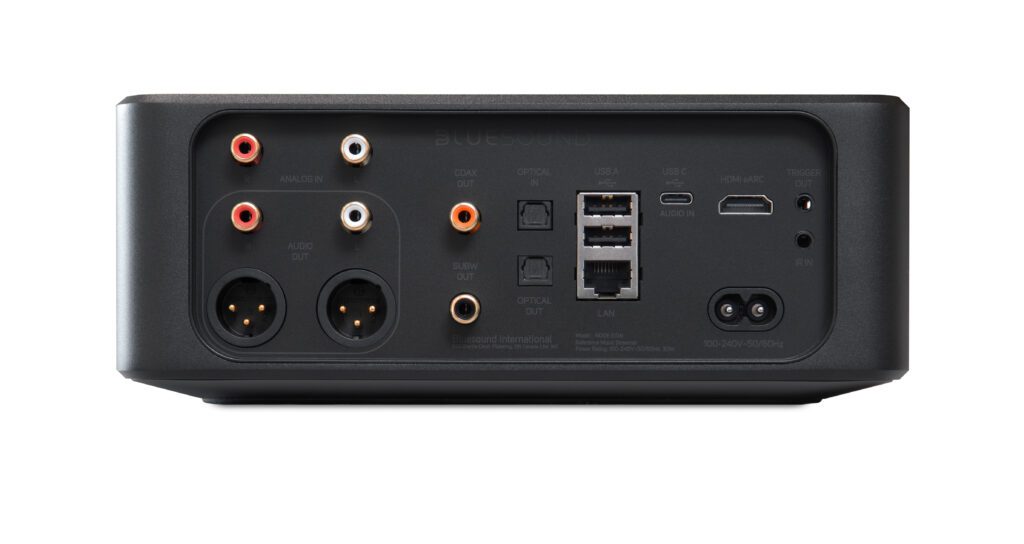
This is converted to digital as a function of how the ICON works, but it is useful to have nonetheless. In addition to RCA and XLR outputs, the ICON features a THX AAA-based headphone amplifier with a 6.35mm headphone socket on either side of the casework for convenience. If you gave up on wired headphones years ago, there is a two-way Bluetooth option. That allows for the use of wireless headphones as well.
Looking sourcey
Beyond its attractive appearance as a source component, the ICON features a 100-step volume control that can serve as a preamp. Although all Nodes can be used in this manner, the ICON uniquely integrates this functionality with connectivity, implying it could be the only front end you genuinely need. Enhancing this capability is the introduction of Dirac room optimisation support. This allows for adjustments to either just the lower frequencies or to a comprehensive 20Hz-20kHz adjustment, for £249.
You will likely also need a microphone, and the cost of these items may push the total cost of the Blusound above the sub-£1k range. However, for those with less-than-ideal rooms, this option becomes very enticing, especially compared to the more straightforward EQ systems offered by some competitors.
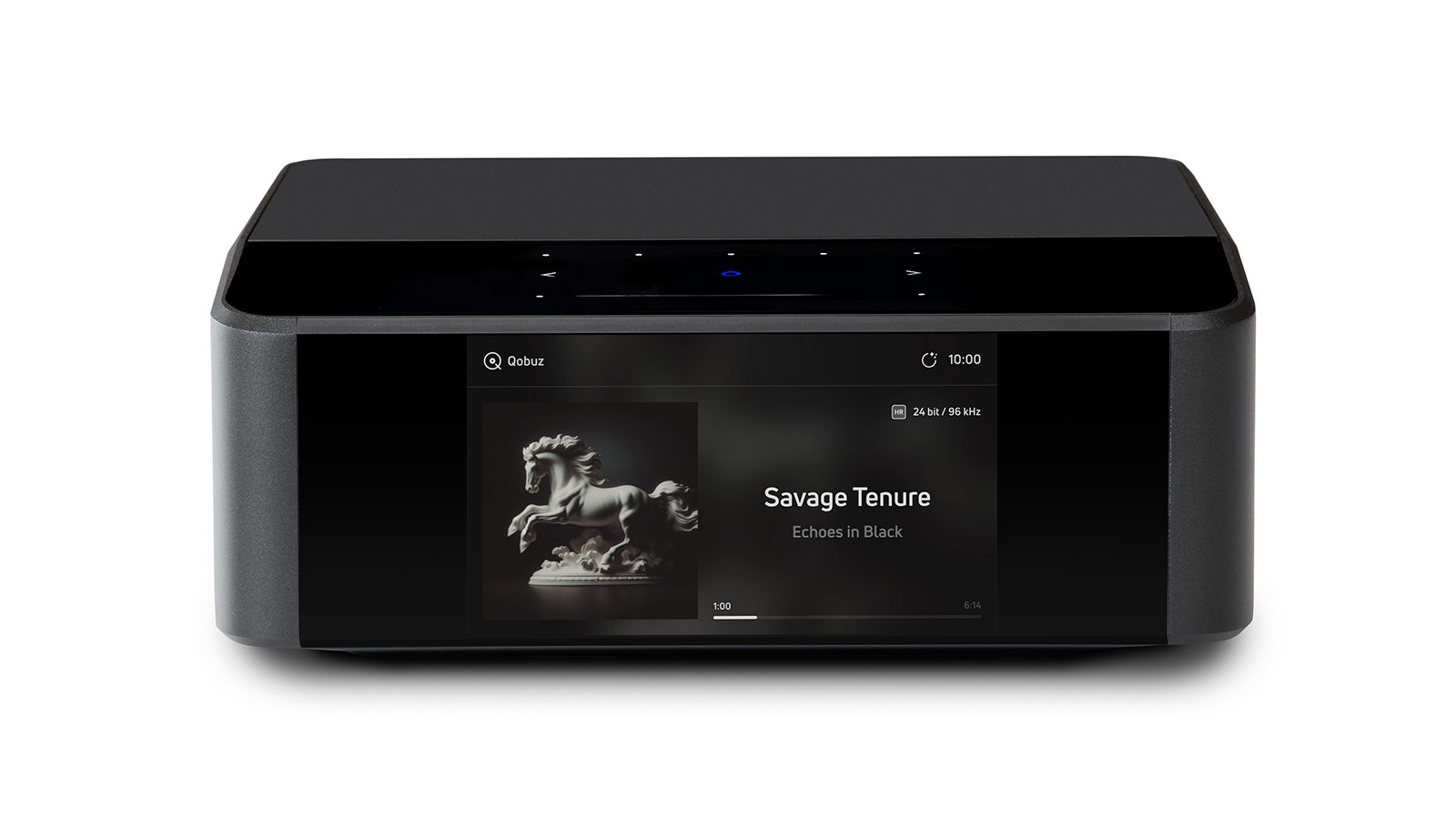
The ICON is constructed with casework that marks a significant departure from the more affordable Bluesound models. This is the first Bluesound product to be built in a metal chassis, and it looks and feels like a far more serious piece of hardware compared to the smaller Nodes. It’s not a beautiful object; few streamers are, to be fair, but it exudes a sense of purpose that is lacking in the lesser models.
Some of this can also be attributed to the inclusion of a full colour display for the first time. The display is not a touchscreen, as there is a second illuminated touch panel above it that serves as a control point. As a traditionalist, having an actual volume knob would have been nice, but it’s difficult to find fault with any other aspect of the ICON’s design and build.
Evident cleverness
Despite the cleverness evident in the ICON’s specifications, I suspect many will operate as line-level sources into an amplifier. The good news is that it justifies its existence even in this uncomplicated configuration. Play the intensely dynamic ‘Superkilen’ by Svanenborg Kardyb [Gondwana], and there’s a distinct quality of high-end performance in how Bluesound manages the dynamics and scale of this deceptively powerful album. There isn’t ‘more’ bass compared to more affordable digital front ends, but the depth and definition are significantly enhanced.
Further up the frequency response, the ICON remains impressively assured. What Bluesound achieves with remarkable consistency is the employment of superior decoding and output to create a sound that feels larger, more spacious, and inherently more natural than what the smaller Nodes can provide. Given the competitiveness in streaming, there realistically isn’t a definitive ‘killer blow’ to be dealt here, but the ICON certainly holds its own.
Having done so in this most conventional of use cases, the ICON really begins to show its worth as a preamp. Its time on test coincided with a pair of PMC twenty5 23i Actives being on hand. Connected via XLR, the Bluesound began to show some genuine star quality from a very compact system.
Not just basic coverage
It covers all the basics exceptionally well. The volume ramp is beautifully linear. It allows fine adjustments and proves just as convincing at low levels as when the taps are opened. The superb live recording of My Baby’s Acoustic Blues Club [Self-released] positively crackles with the energy of a remarkable band performing before an engaged audience. You quickly forget the hardware involved and simply immerse yourself in the music being created.
Running the Dirac software with this combination helped manage a minor room node at 50Hz and a slight dip in the midrange. Without sacrificing the unique character of the two components, I found that I could push a bit harder and enjoy a more natural performance. You can then pause the music, switch on the television, and experience a performance that is equally captivating yet requires no more thought to access than a soundbar.
Even with a Rega Planar 10 and Cyrus Classic Phono connected to the analogue input, there were no significant limitations. If I had to choose, I would slightly favour Eversolo’s DMP-A8. That one keeps its analogue inputs in the analogue domain. However, it is considerably more expensive and less cohesive to operate.
There’s more…
The ICON doesn’t stop there either. I have previously encountered Bluesound’s AAA headphone amp with the limited-edition Node X. So it’s not a complete surprise to me, but the result is still remarkably good. Using a pair of Focal Clear MG headphones, a listen to ‘Every Day’ by the Cinematic Orchestra [Ninja Tune] is not merely ‘good for a streamer attempting to double as a headphone amp’. It’s one of the most confident headphone performances I have experienced under a grand. If you regularly listen to headphones, you must give the Node ICON a try.
In fact, there aren’t many use cases it covers where the Node ICON doesn’t merit consideration. Bluesound has taken the time to evaluate where new arrivals have clear strengths. It has proceeded to develop a product that, at the very least, can compete on an even footing. More often than not, though, it outperforms its rivals. Equally significant is the fact that this impressive capability is harnessed in a device that is hardly more complicated to use than a knife and fork.
The Bluesound Node ICON offers an impressive range of features in an entirely approachable manner. This may well represent the standard for engineering responses. It effortlessly demonstrates to newcomers that the established norm can still challenge them. Better still, it does so on their own terms and shows them how it’s done. Referring to your product as an icon is a bold assertion, but Bluesound has certainly lived up to it.
Technical specifications
- Type: Streaming DAC Preamplifier
- Digital inputs: HDMI eARC, USB-A (external storage), USB-C (PC input), Ethernet RJ45 (Gigabit 1000Mbps), TOSlink optical S/PDIF
- Wireless inputs: Wi-Fi 5 (802.11ac), dual-band, Bluetooth 5.2 aptX Adaptive
- Analogue Input: RCA stereo pair, IR optical sensor and 3.5mm jack
- Audio Outputs: Analogue RCA Stereo with Fixed option; Balanced XLR Stereo with Fixed option; USB Audio 2.0 (Type A), coaxial RCA/TOSlink optical S/PDIF, 12V trigger, Subwoofer RCA (wireless connection to Pulse Sub+)
- Headphone Output: 6.3mm/1/4” Stereo x2; Bluetooth
- Supported Audio File Formats: MP3, AAC, WMA, WMA-L, OGG, OPUS
- Supported High-Quality Audio File Formats: FLAC, MQA, ALAC, WAV, AIFF, MPEG-4 SLS
- DSD Support: DSD256
- Supported Multi-Channel Audio Formats: Dolby Digital®
- Native Sampling Rates: up to 192 kHz
- Bit Depth: 16-24
- Audio Controls & EQ: BluOS Controller App
- DAC: ESS ES9039Q2M x2
- Signal-to-Noise Ratio: XLR: -129dB, RCA: -121dB
- Distortion: THD+N: 0,0004%
- Headphone Continuous Output Power (THD<0.1%): 160mW, 16Ω / 235mW, 32Ω / 56mW, 250Ω / 23mW, 600Ω
- Product Dimensions (W x H x D): 22 x 8.4 x 19.3 cm
- Weight: 2.23kg
- Price: £899, $1,399, €1,095
Manufacturer
Bluesound
Trending Articles
See all
By Ed Selley
More articles from this author

Read Next From Review
See all
D’Agostino Audio Pendulum
- Jul 14, 2026

Meze Audio 105 AER
- Jul 14, 2026
REL T/9x SE
- Jul 14, 2026
Pro-Ject Speaker Box 5 E Carbon
- Jul 14, 2026