


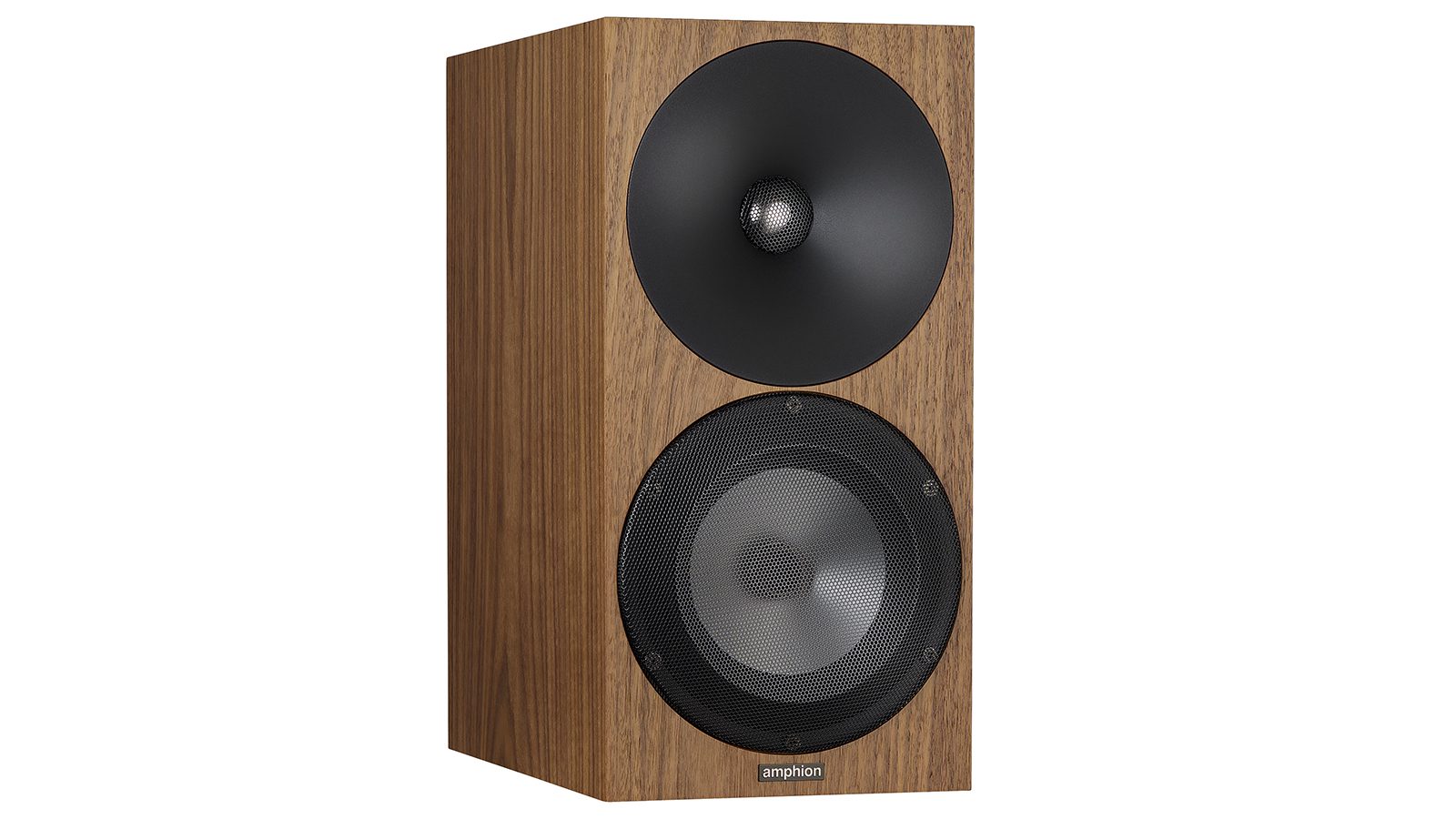
Just under five years ago, I reviewed the understatedly excellent Amphion Argon3S stand-mounters for Issue 195. Then, a little over a year ago, I took on their mighty Krypton3X floorstanders for Issue 237. Both loudspeakers impressed me greatly, but in some respects the smaller loudspeakers are the more significant. Why? Because they will find their way into rather more homes than the Kryptons. That’s the joy of the Amphion Argon3X.
The Argon3X is the latest iteration of the Argon3 models and replaces the Argon3S. It is the larger of two stand-mounters in a four-model line-up. The Argon3X sits above the Argon1 and below the Argon3LX and Argon 7LX, both floorstanders. It is by no means a large loudspeaker, though it is somewhat deeper than you might expect from the front baffle size. This means the cabinet volume is greater than in many designs with a similar visual footprint. Amphion’s subtly chalky black or white finishes (in reality, a dark charcoal grey and a soft white) also help it recede into the background visually. So, it looks smaller than it is. It’s also a little bit heavier than you might expect – there’s clearly plenty going on beneath the surface.
Series crossover
There’s no doubt that Amphion’s flagship design, the Krypton3X, is a very special loudspeaker, and in my opinion, a significant part of its specialness derives from Amphion’s decision to use a series crossover design rather than the usual parallel crossover configuration. The other key aspect is its quite extraordinary tweeter. The series crossover, by its nature, provides better control and damping of a driver outside its operating range. By not splitting the signal into low- and high-frequency components at the outset, it offers the potential for better integration and cohesion; a parallel crossover divides the signal into sections, which the crossover implementation with its drivers then has the job of re-integrating, acoustically. The series crossover mitigates that issue somewhat, by the nature of its design. A secondary, but still valuable, benefit is that the impedance varies much less across the frequency range, giving amplifiers an easier load to drive.

The Argon3S was already a very good loudspeaker – for me, one of the few genuinely benchmark loudspeakers at its price – but the Amphion Argon3X has moved the game on a bit. Well, quite a lot, actually. Interestingly, while a parallel crossover is the more conventional configuration, the series crossover was not a new concept for Amphion. They tell me the outgoing Argon3S also uses one. It was noteworthy in the Krypton3X because it is considerably more difficult to implement a series crossover successfully in a three-way design. So it’s perhaps best not to attribute too much of the change in performance to the series crossover in the Argon3X; that said, the crossover has undergone substantial revisions.
New tweeter
That’s been necessary because there’s also a new tweeter; still titanium, still time-aligned in its clever waveguide, but with much higher performance, as its quoted frequency range makes clear. It is essentially the same unit used for the £18,000 Krypton3X. Consider its upper rolloff point, raised from 25kHz in the Argon3S to an extraordinary 55kHz in the Amphion Argon3X. Amphion literature quotes 38Hz-55kHz at -6dB; in reality, the upper extension doesn’t change much for the more usual -3dB measurement, but the bass goes a little deeper at the -6dB point (no doubt a nod to the degree of in-room reinforcement many listeners may enjoy). The crossover point remains a low 1600Hz, the same as for the -3S, aligned with Amphion’s determination to keep the critical crossover region below the human ear’s most sensitive range.
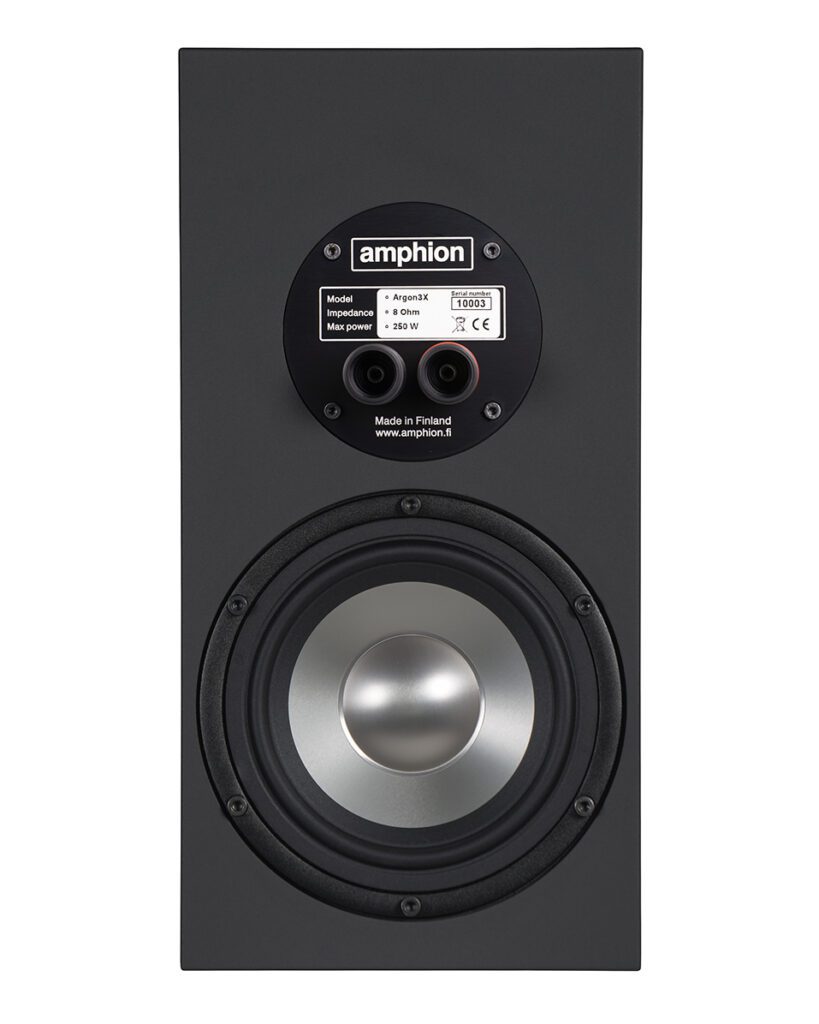
Visually, the loudspeaker is almost identical to its predecessor, with the same physical dimensions, similar weight, and the same choice of finishes, although the walnut finish is now a no-cost option. It’s still a sealed-box design using a rear-mounted aluminium passive radiator rather than the much more common reflex port. This helps greatly with both bass control and quality, and also with placement, as the Amphions are much more tolerant of near-wall (or indeed wall-mounting) locations than many of their reflex-ported peers.
Well-damped
The Amphion sound has always felt well-damped, not in the sluggish, lifeless sense that many speakers using heavily damped cabinets can, so the benefits of the series crossover may explain some of the thoughts I’d not previously articulated.
Compared with its peers, the Argon3X is operating on a higher plane, against more expensive competitors than before: the -3X retails for £3,400, whereas the outgoing -3S retailed at £2,800, and I’m aware there’s been some comment online about this price jump. Frankly, given the quality of the new tweeter, keeping the price increase to ‘only’ £600 is a remarkable achievement. All I shall say is that it seems to me that those making critical comments cannot have heard the Argon3X in action, because doubts about questions of value are likely to evaporate almost the first moment you hear them.
Performance
Listening to Leonard Bernstein’s account of Mahler Symphony No. 1 with the Concertgebouw [DG], the depth of the soundstage and the ‘walk-round’ holographic imaging are striking; the orchestra is resolved almost to the level of individual instruments. The Amphion Argon3X is so lucid that it makes it easy to follow the structure, line and arc of the music; how the various parts are interwoven by the composer and performed by the musicians; how musical fragments are passed around the parts, played in ‘call and response’, or repeated quietly by one section while the rest of the band has moved on; how the different themes are introduced or interact; and how this all combines to produce the work we experience.
This level of discrimination between the parts is something I have rarely experienced in loudspeakers, at this price or considerably more. These are the sort of insights we hope to get from live performances, but many loudspeakers, especially sub-£5k loudspeakers, tend to subsume the subtler elements, most particularly during the busier passages.
More than a party trick
It’s more than a party trick, too. I’ve long been in the ‘detail is a nice-to-have rather than a must-have’ camp, partly because some systems that present micro-detail do so analytically, deconstructing the sound rather than reconstructing the music. But there’s no denying that this degree of cohesion, intelligibility and insight into the structural bones of the work helps us listeners make more of the music. The Mahler is dripping with emotional impact, which Bernstein draws out sensitively and subtly, and the Argon3X allows all this communication to happen without inserting itself conspicuously into the work.
Couple that extraordinary level of structural insight with a soupçon of tonal honesty, expressive dynamics, and nicely judged control without over-damping, and the overall effect is that the musical intent is communicated clearly and without significant extraneous distractions. Which is reviewer-ese for ‘these loudspeakers really show you what’s great about the music you’re listening to’. Laura Jurd’s title track from Landing Ground [Chaos Collective] is urgent, vital, tight and together; Jurd’s trumpet is fluid, the string quartet is sinewy, the percussion is fast, complex and nuanced; all the musicians are clearly at the top of their game and having a blast, and it’s easy to get carried along by the infectious energy in the room.
Similarly, listening to ‘Almost Sophia’ from Learning to Wave [Antilles], you’re more aware that this is complex, layered music: the tabla is fast, tactile and solid, and the interplay between Andy Sheppard’s sax and John Paricelli’s guitar is subtle, fluid yet firmly and securely rooted. This is all extremely accomplished jazz, but above all, it’s just great music, performed by great musicians.
Small big ‘un
The Argon3X remains a smallish stand-mounter, not a full-range design, so it won’t deliver scale and mass like a big ‘un can, but it does everything else so well that it hardly matters. This new tweeter seems instrumental in elevating the Argon3X’s capabilities; its ability to maintain the integrity of a complex, layered, highly dynamic signal is truly remarkable. So often a shiny new tweeter just adds a bit of polish to the upper ranges, or deals with a bit of sibilance or harshness. When that’s all it achieves, it’s an opportunity missed.
Amphion has seized the initiative, however, and I suspect the series crossover plays its part. It brings organisation and composure in the face of complexity, and allows that mega-tweeter full expression. I’m not sure about operating on a higher plane against more expensive peers; I’ve met very few loudspeakers at this price that deliver what the Amphion Argon3X can.
Technical specifications
- Type: Two-way, stand-mount loudspeaker
- Driver complement: 1 x 1” titanium tweeter; 1 x 6.5” aluminium woofer; rear-mounted 6.5” aluminium passive bass radiator
- Crossover frequencies: 1600 Hz
- Frequency response: 38 Hz – 55,000 Hz (-6dB); 45Hz – 55,000Hz (-3dB)
- Impedance: 8Ω
- Sensitivity: 87dB
- Power handling: 50-250 W (recommended)
- Dimensions (HxWxD): 380 x 190 x 305 mm
- Weight: 10Kg
- Finishes: white (accent colour options available for driver grilles); black; walnut
- Price: £3,400, €3,750, $5,398 (all finishes)
Manufacturer
Amphion Loudspeakers Ltd
Homepage – https://amphion.fi/
Product – https://amphion.fi/products/argon3x/
Where to buy – https://amphion.fi/where-to-buy/
UK distributor
Auden Distribution
+44(0)7917 685759
Trending Articles
See all
By Steve Dickinson
More articles from this author
Read Next From Review
See all
D’Agostino Audio Pendulum
- Jul 14, 2026
Meze Audio 105 AER
- Jul 14, 2026
REL T/9x SE
- Jul 14, 2026
Pro-Ject Speaker Box 5 E Carbon
- Jul 14, 2026