


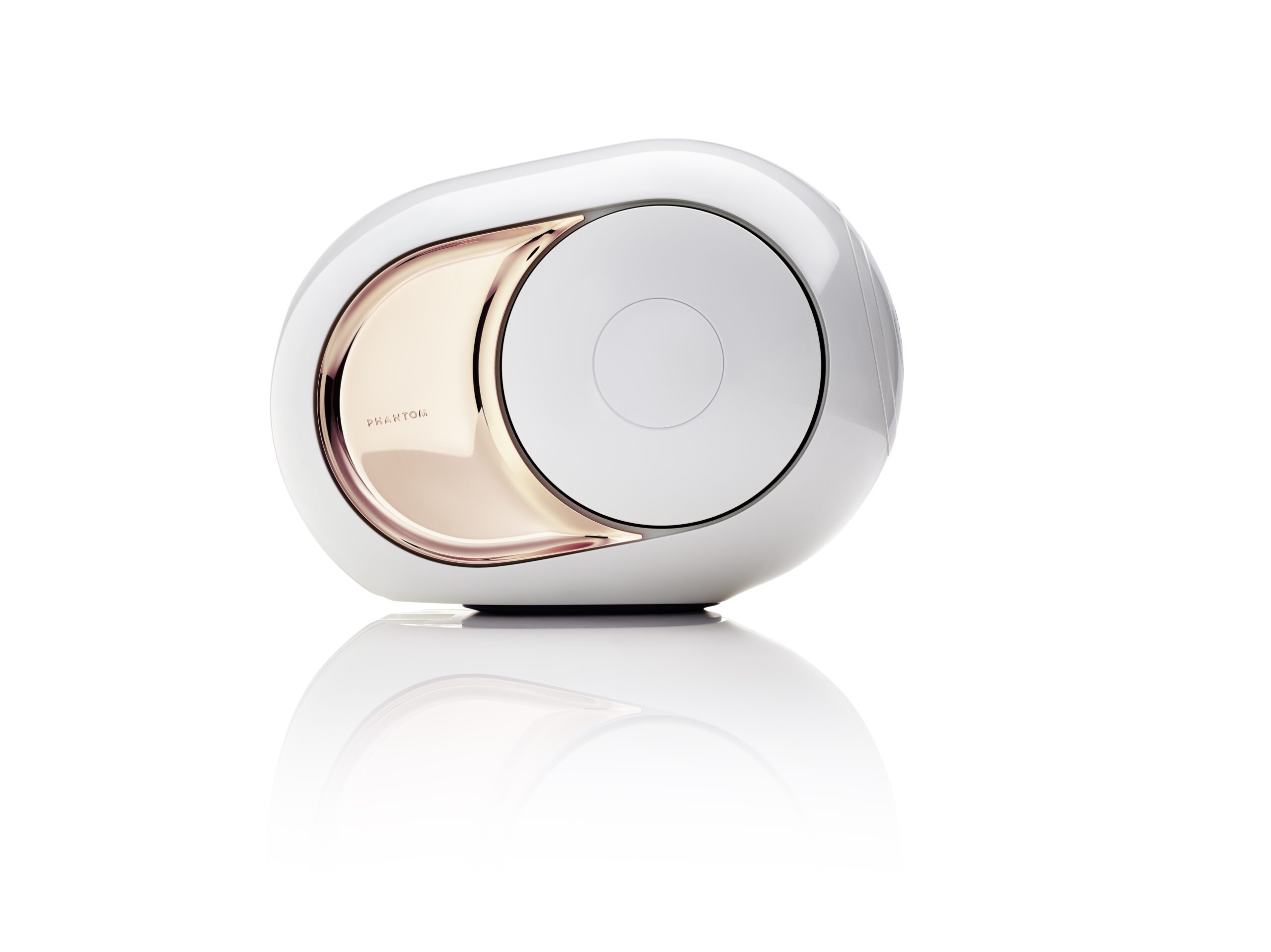
Although Devialet has branched out into other aspects of audio (including most recently… earbuds), the hi-tech French company is perhaps best known for its Expert Pro amplifiers and its Phantom wireless active loudspeakers. This last has been the subject of some substantial change, with the development of the smaller Phantom II system. However; there’s still a lot of mileage in the original Phantom I, especially as it has received a substantial boost lately.
It’s worth going over a bit of Phantom history first. Devialet announced the original Phantom in 2014 and by 2016 there were three versions (standard, Silver, and Gold), these were beefed up again in 2017 and once more in 2020. Recently they were joined by a smaller system (originally called ‘Premier’ and ‘Reactor’, but now known as Phantom I and Phantom II) and both lines feature different models that provide more power and higher SPL levels as you go up the range.
In both lines, the tippity-top of the range is the Opéra de Paris, but there’s an otherwise identically specified and – and a bit cheaper – model without the famed opera house’s seal of approval and with rose gold instead of antique gold side cheeks. Let’s be clear, however, the latest Phantom I 108dB may look like a Phantom Gold of five years ago, but the all-important internal processing power and the ADH amplifier circuitry have all been updated. Mostly.
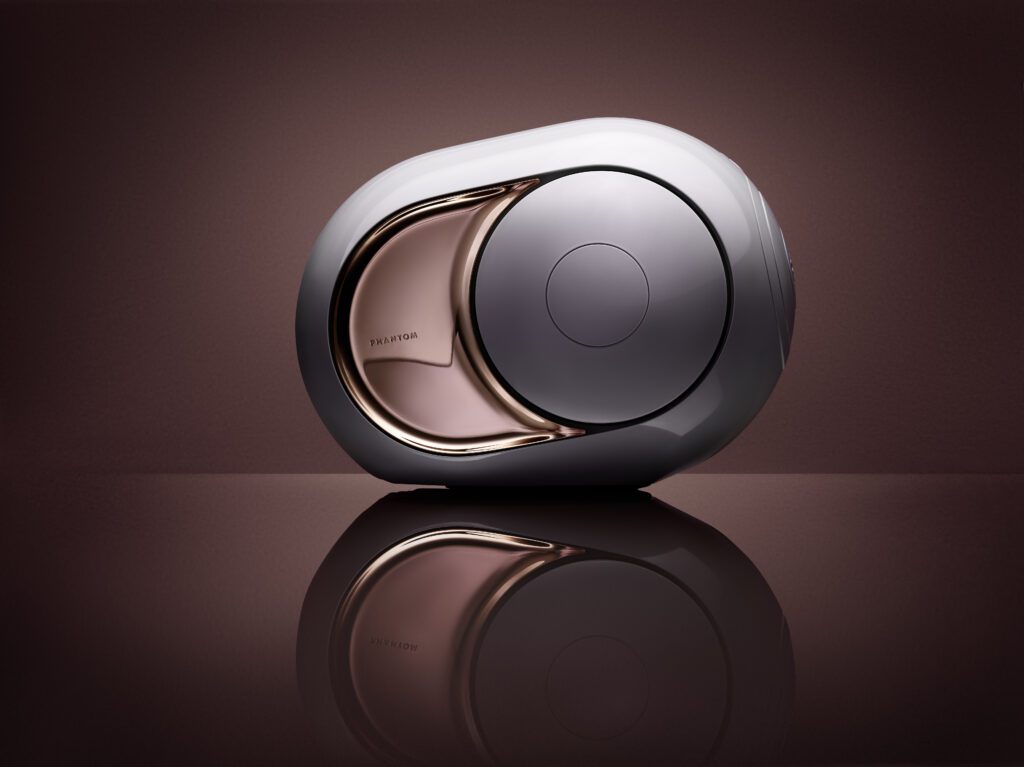
Devialet Phantom I Updates
The ‘mostly’ part refers to the DAC itself. I’m not sure how much of an issue this is to the target audience of the Phantom I, but its internal DAC remains a 24bit, 96kHz affair, with the second version of Devialet’s operating system itself topping out at 24bit, 48kHz. Why I’m not convinced this is an issue is because the wireless nature of the Devialet loudspeaker makes the notion of streaming very hi-res files ‘challenging’ at best; limiting such file sizes means easier music delivery with fewer drop-outs and – in the case of multiple Phantoms – reduces the risk of latency problems. It’s also never likely to be an issue through the Devialet Phantom I’s preferred musical pathways of Spotify Connect and Bluetooth, or even the optical digital connection provided at the rear. Nevertheless, by current audiophile standards, anything below 32bit, 384kHz with DSD512 and MQA support is perceived as a pinch-point.
Devialet still bristles with TLAs (three letter acronyms). There’s ‘ADH’ (Analogue Digital Hybrid) of course, a design that couples a small, lovely sounding Class A amplifier for that all important first watt or so of sound coupled to a more powerful Class D amplifier for the heavy lifting amp tasks. While it’s a misnomer calling Class D ‘digital’ (technically it’s using pulse-width or pulse-density modulation to drive the output devices of an amplifier as very high frequency switches), this is a somewhat academic distinction; but remember the ‘D’ in ‘Class D’ does not stand for ‘digital’. This itself is subject to its own ‘SoC’ (System on Chip) acronym in the Phantom range.
Staying with the acronyms, the ADH amplifier is coupled to the HPI driver system. While ‘Heart Bass Implosion’ might sound like Shōjo Manga or the difficult third album from a 1980s New Romantic band, it’s a useful and descriptive way of highlighting the differences between the pulsating parallel lateral woofer system used in the Phantom and the more traditional cone woofers found in most other loudspeakers. Play a deep bass note and the sides of the Phantom expand and contract like a beating heart, so ‘Heart Bass Implosion’ isn’t too far of a descriptive reach. This is further acronymed to the max by the ‘ACE’ Active Cospherical Engine, which is a neat way of saying the treble unit sits in the acoustic centre of the midrange driver and both are driven actively. In fairness to Devialet, it credits the idea of a pulsating sphere of sound to loudspeaker pioneer Harry F Olsen.
Tags: DEVIALET PHANTOM I 108DB WIRELESS ACTIVE LOUDSPEAKER SYSTEM
Trending Articles
See all
By Alan Sircom
More articles from this author

Read Next From Review
See all
D’Agostino Audio Pendulum
- Jul 14, 2026
Meze Audio 105 AER
- Jul 14, 2026
REL T/9x SE
- Jul 14, 2026

Pro-Ject Speaker Box 5 E Carbon
- Jul 14, 2026