


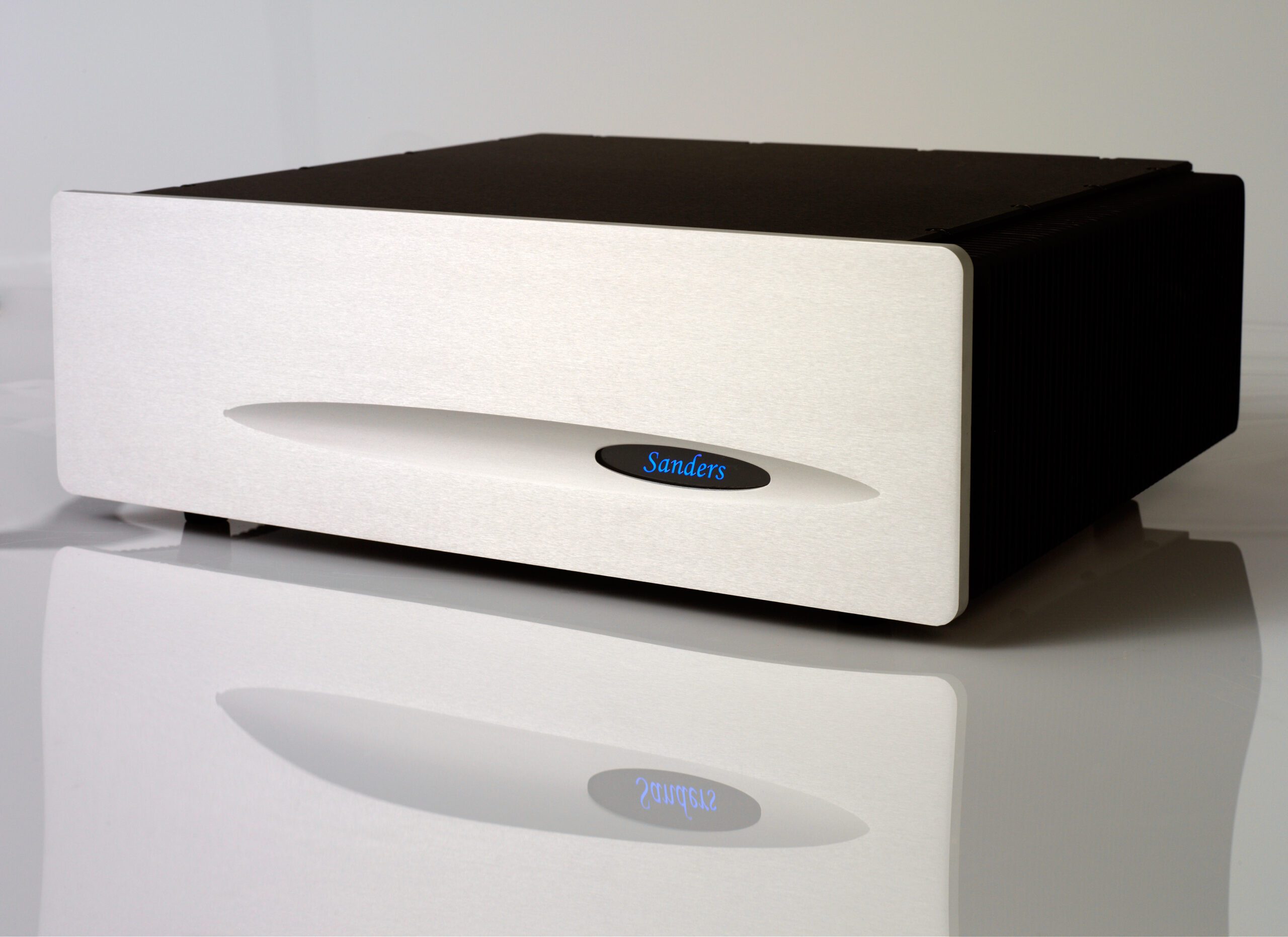
The Sanders Sound Systems Magtech is not your ordinary Class AB amplifier.
Sanders Sound Systems has been around for over four decades. Based in Conifer Colorado, USA, Founder Roger Sanders is a scientist and engineer first and foremost. His interest in Electrostatic loudspeakers has led to the creation and continued development of the Model 10 Electrostatic Speaker. The Model 10 has been rightly feted with many awards for its lifelike presentation and accuracy. Generally, Electrostatic speakers have required a lot of power and stability from an amplifier to maximize their qualities. Roger, not being satisfied with what the market offered, spent two years developing the Magtech amplifier to drive the Model 10’s.
At first glance, the Magtech amplifier (I received the stereo version. The mono amps look identical.) is handsome, but unassuming. Enclosed in an understated black aluminum case with a classy not flashy thick front panel with the Sanders logo in a subtle blue light and heat venting fins that will not slice your hand to pieces, the Magtech sits on your shelf looking very business-like. Weighing in at a manageable 25 Kg the amp is easily moved as needed. On the back you find XLR and RCA inputs alongside speaker terminals that will accept spades, bananas, or bare wire. So far, no surprises. It is when the insides are considered that you begin to discover the Magtech is not your ordinary Class AB amplifier.

Speaking with Roger Sanders about his design goals for the Magtech, he indicated that to have an amp that has a lot of control over the speakers, he needed a lot of power. Indeed, the Magtech stereo amp provides 500 wpc into 8 Ohms and 900 wpc into 4 Ohms alongside an extremely low output impedance. Most important though is the fully regulated power supply. The “why this matters” question gets to the heart of Sanders design philosophy. He is a scientist and engineer rather than an audiophile. He is an objectivist to the core and will make sure his designs spec to the best level he can manage. The result will be performance not only beyond what is likely necessary for any pair of speakers but at a constant throughout the power demand that any speaker or music dynamic would require to maintain maximum unaltered signal quality.
To get to the heart of it, Sanders has found that free-floating power supplies cannot maintain their proper voltage during peak music events. The drop in voltage reduces the available output power significantly and it leads to clipping reducing the quality of the amplified signal. Thus, the critical need for a fully regulated power supply. He has invented the first fully regulated power supply that generates virtually no waste heat. It is almost 100% efficient. This power supply maintains its voltage, high power, and bias level regardless of the load placed upon it. Sanders indicated he uses the latest thermal track transistors by Motorola which keeps the bias under tight control. So, he can run the amp at low bias while maintaining very low distortion levels at around 0.0001%. He also stressed that this amplifier had no protective circuitry as that leads to compromises when powering electrostatic speakers. So how do you keep from blowing up your output transistors? The answer is he uses a whole lot of powerful output transistors to reduce the strain on any single one. Looking at the picture of the amps internal circuits will show twenty transistors per channel wired in parallel spreading the stress across the group of them and lowering the impedance to around 1/100th of an Ohm which means it can deliver all the current a speaker needs regardless of frequency or impedance.
Sanders stated that the audio press spends little time discussion protective circuitry. Everyone is looking for the holy grail of an amplifier that sounds good all the time. They usually think that one sounds better than another because of design parameters but in his view in most cases that is not true. A solid-state amp that has a transistor sound is not due to having transistors but due to the fact is has protective circuitry. When protective circuitry is triggered, it cuts the power to the output circuitry. It does this rapidly so it does not have an obvious chopping off the music but that is exactly what is happening several hundred times a second. When that happens, you have gaps in the music however brief or small. They are still discernible. On an oscilloscope you can see the music being cut on and off as the protective circuitry is being applied. Voltage spikes from a light switch or an output transistor also impact the linearity of the music signal. So protective circuitry leads to gaps in the music with voltage spikes on either side of that gap. It is no wonder this sounds bad. There is significant distortion and a limitation of the power available from the amplifier. This is usually perceived as brittle, harsh or edgy when describing the sound. Perhaps the biggest negative is the protective circuitry is triggering on peaks which are very short, so the listener is not recognising the distortion during that brief peak. The average level still sounds clean because you are not triggering the protective circuitry, yet the amp is still described as brittle and edgy.
Trending Articles
See all
By Eric Neff
More articles from this author


Read Next From Review
See all
D’Agostino Audio Pendulum
- Jul 14, 2026
Meze Audio 105 AER
- Jul 14, 2026
REL T/9x SE
- Jul 14, 2026

Pro-Ject Speaker Box 5 E Carbon
- Jul 14, 2026