

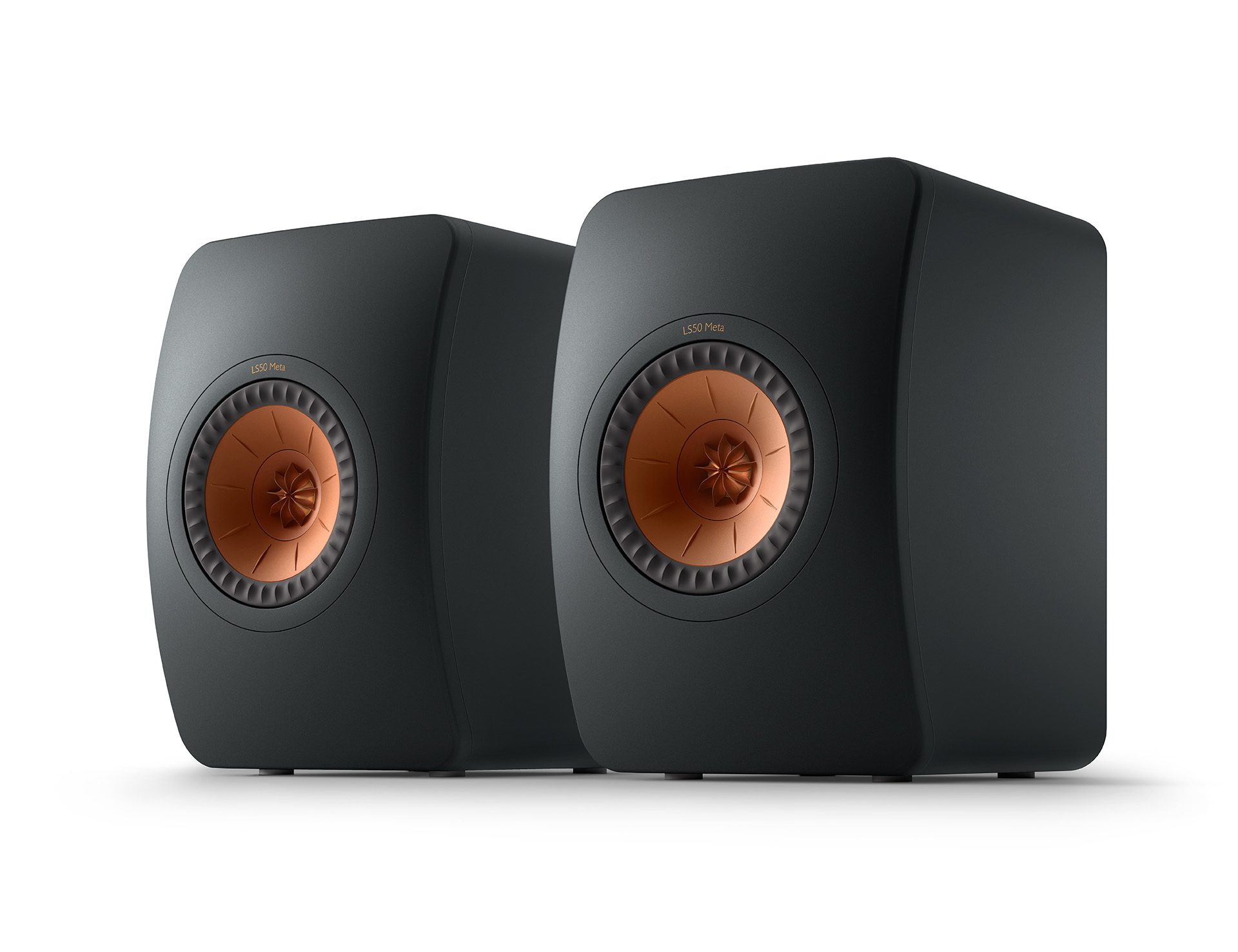
Unless you have been spending WAY too long in your man-cave in recent years, you will have heard at least something about the KEF LS50 in all its active and passive guises. Originally inspired by the LS3/5a but brought very much up to date with KEF’s latest Uni-Q driver array, the small, high-performance stand-mount has been the loudspeaker to beat since it first appeared almost nine years ago.
If, as Rab Butler said, “a week is a long time in politics”, then nine years is a lifetime for a loudspeaker. Few of the LS50’s peers from 2012 are still around in their same iterations, but it’s something of a testament to the original LS50 design that it took until the latter part of 2020 for its LS50 Meta replacement to roll out, and on the face of it, differences are minimal in the extreme. The LS50 Meta has the same form-factor, the same basic cabinet construction (a resin/GRP compound to produce the gently curved front baffle, with a braced MDF cabinet for the rear and sides). The cabinet has been cleaned up slightly, but you really need a pair of original LS50s in a side-by-side comparison to spot the cleaner rear panel (no more visible bolt holes holding the front baffle in place). But the only real changes are additional colourways, such as the Royal Blue version I received.

No, the changes are more to do with the Uni-Q driver itself and the crossover network, and both of these are extremely difficult to see even on close inspection. The most significant of these changes is ‘MAT’ (short for Metamaterial Absorption Technology). This is an internally mounted labyrinth behind the aluminium tweeter at the acoustic centre of the Uni-Q cone. The 30 tubes inside this MAT are designed to absorb different frequencies from about 600Hz on up, in the process reducing rear resonance firing into the cabinet itself. Meaning the already inert cabinet is even less likely to sing along with the tweeter, making a sound that is less distorted at high frequencies and high levels. The drive unit itself has been re-engineered to reflect eight years of R&D.
An essentially ‘new’ Uni-Q driver requires a new crossover network, but these appear relatively minimal, with just a mild change to the crossover frequency, down by 100Hz to 2.1kHz. Everything else reads as it did in 2012. That means the LS50 Meta follows the LS50 in being relatively undemanding a load; 85dB sensitivity isn’t ‘high’ and that – coupled with a minimum impedance of around 3.5 ohms – means a little more care and attention in partnering is required. KEF is often demonstrated with Hegel at the moment, and this happens to be an excellent combination. But realistically, most competent modern amplifiers will work well.
Setting up Uni-Q-based speakers can be slightly different to the norm, in that often toe-in is negligible, and the speakers end up firing down the room almost parallel to one another. They need some breathing space from the rear wall, however, and at least half a metre will help.
Trending Articles
See all
By Editor
More articles from this author


Read Next From Review
See all
D’Agostino Audio Pendulum
- Jul 14, 2026
Meze Audio 105 AER
- Jul 14, 2026
REL T/9x SE
- Jul 14, 2026
Pro-Ject Speaker Box 5 E Carbon
- Jul 14, 2026