Up to 37% in savings when you subscribe to hi-fi+

Begin typing your search above and press return to search. Press Esc to cancel.

The Smile: Wall of Eyes

Wall of Eyes is the second album from The Smile, following 2022’s A Light for Attracting Attention. Despite being released in January this year, a third album, Cutouts, appeared in early October. The Smile features two of Radiohead’s core members – lead singer Thom Yorke and Jonny Greenwood with Tom Skinner, hitherto best known as the percussionist from the late, lamented avant-garde jazz band Sons of Kemet. As the last full Radiohead release was 2016’s A Moon Shaped Pool and Sons of Kemet went on perma-hiatus in 2022, The Smile is (hopefully) proving more than just a side project.

As Wall Of Eyes by The Smile started, I thought, “This is good!” Feelings rushed back from Radiohead’s legendary OK, Computer. It’s the same feel and the same sound. Thom Yorke’s fragile, high-pitched voice is a simple yet effective instrumentation. Guitars mixed with electronic sounds and incredible indie rock drumming. This is really good! At the end of the first track, their Talk Talk inspiration becomes apparent again, as it was many times with other Radiohead albums.

One feature inspired by the band Talk Talk that Radiohead has adapted is the interchange between passages of extreme musicality, which transmute into distorting passages that remain musical.

The music on the opening title track, ‘Wall of Eyes,’ is laid-back and minimalist. It evolves into increasingly distorting sounds. The second track, ‘Teleharmonic,’ is similar but more ethereal and still good. It starts quietly but builds with great bass and excellent drumming. 

Things get noisier on the third track, ‘Read the Room’. Thom Yorke’s vocals are great on this track. And there’s more great drumming from Skinner. As with the first tracks, ‘Read the Room’ dissolves into more distorting elements as the song progresses.

After the first three tracks, which could all become indie-rock hits, the album becomes more atmospheric, nuanced, and slightly off-beat. For example, ‘Friend of a Friend’ has an almost Abbey Road feel, like a modern Beatles version of one of the tracks Paul sang on that album, complete with tempo breaks, piano and similar phrasing.

The first part of the album is very appealing from early listening. The second half requires more listening time before it reveals itself, which might appeal to only some listeners. That said, Radiohead and Sons of Kemet fans are the kind of listeners who enjoy taking the time ‘going to work’ on an album, so if Wall of Eyes takes time to parse, that’s a good thing!

Many of the lyrics on Wall of Eyes seem very personal to Yorke, like torn sentences glimpsed from entries into his private diary. The songs feel like he’s expressing disappointment or commenting on the various people and experiences in his interactions with the world as a famous musician. On the quiet and reflective ‘Bending Hectic,’ for example, Yorke seems to slightly echo Lennon’s outlook on ‘Watching the Wheels.’ That track also has a slight later-years Beatles feel to it.

If Radiohead has pressed ‘pause’ on new material releases, then Radiohead and indie-rock fans generally have an excellent new artist to follow. One that seems to be cranking out new material at a healthy pace. Wall of Eyes is more reflective and less ‘flashy’ than early Radiohead albums. 

This is more like a mix of Radiohead’s earlier quiet tracks and later more electronic introspective material. Wall of Eyes is undoubtedly a must-have. 

A final bonus is that the album is recorded rather well for the genre, too. A number of UK audio reviewers – including the editor of this title – have been known to use Wall of Eyes as one of their test records.

Back to Music

Atlas Cables Arran Ultra L RCA Grun

In the dim and distant past that we call ‘the nineties,’ a charming Scotsman named John Carrick distributed a Japanese cable brand, Furukawa. He had a degree of success with these cables, which were made using a technique called Ohno continuous casting (OCC), which involves using heated moulds to draw long single-crystal copper (or silver) conductors. I used some of these cables for a while, but they were inevitably replaced by something better or something that sounded better in the system than it was at that time.

Last year, I was looking for a cable for a friend and came across a Furukawa interconnect. I went to check that it worked and see how it sounded today. The result was surprisingly appealing; this 25-year-old plus cable had a depth of tone and warmth that is uncommon among many of today’s offerings. The Furukawa didn’t have the detail and speed of modern interconnects but did enough to make me wonder about the technology.

Enter Atlas

When I recalled that John Carrick went on to found Atlas Cables and that this company uses OCC in its cables today, I contacted Kevin Kelly, who runs Atlas, and asked if I could try a modern example of the breed. He sent two pairs of Arran Ultra L RCA Grun interconnects, which have 6N purity (99.9999%) OCC copper conductors. These have a microporous PTFE dielectric, which means the insulation is wrapped rather than extruded to get some air around the conductor. The construction is defined as a twin multi-core, dual drain, which means that it has four cores in two twisted pairs and that two drain wires spiral at 180 degrees to one another beneath the screen, a technique that significantly increases screening efficiency and keeps RFI at bay very effectively.

The Arran Ultra L RCA Grun cables are the penultimate model in Atlas’ extensive range, sitting below the leather-clad Asimi Ultra L RCA Luxe, which also has the Grun earthing system. This element consists of flying leads connected to the shield at one end of the cable and has a silver-plated threaded coupling that you can earth in various ways. Atlas includes a spade-terminated connector in the box with the Arran cables, which can be connected to an earth point or chassis fixing on the component being hooked up. Alternatively, Atlas offers a power adaptor, which is a 13A mains plug (alternative plugs are available for different countries) with three flying leads that can be joined to the Grun earth leads on the Arran cables.

Tangle teasing

Unusually, these interconnects are not marked for directionality; rather, the end with the Grun connection should be at the preamplifier or integrated amp. So, in a pre/power situation, the connection from a source would have the Grun at the pre-end, and the cable to the power amp would likewise be earthed at the same end. This can be slightly impractical if you change components a lot as avoiding cable tangles gets tricky. However, this is more likely to be an issue for reviewers and dealers than end users.

The ‘L’ in the name of Atlas Arran Ultra L RCA Grun relates to the Latik insulation inside the phono plugs on these cables. Latik is a polypropylene sleeve that replaces the usual PTFE found in high-end RCAs; it has two advantages over that material. By 3D printing this part, Atlas can minimise the amount of plastic and maximise air insulation. The other relates to thermal behaviour; PTFE expands when it is heated up, and this changes the resistance of the insulation and, thus, the performance of the cable. Power amplifiers can get warm enough to do this. Latik plugs are far more thermally stable and do not expand or contract with temperature changes, so the impedance remains constant. 

Atlas further increases cable consistency by using a solder-free connection between the conductor and pin. This is achieved by cold welding, which achieves a smooth signal path at this critical junction. The RCA plugs are shiny on the outside but silver-plated on the pin and collar for optimal contact with the socket. In a perfect world, the RCA socket would also be silver-plated, but such things are rare even amongst high-end components.

Golden tone

Did the Atlas Arran live up to the promise of the vintage Furukawa cable, or was that just a case of age annealing that brought a golden tone to an otherwise average cable? I am happy to say that the Atlas cable not only lived up to expectations but greatly exceeded them. I was hoping for a richer sound; Instead, I got a dramatic increase in detail resolution presented in an entirely fluid and distinctly three-dimensional fashion. Moving over from the interconnects that I have been using for over a decade felt like going from a flat to a three-dimensional soundstage, even though the older cable is no slouch when it comes to imaging. I was, frankly, gobsmacked.

Atlas supplied a 13A plug with only an earth pin to connect the ground wires on two pairs of Arran Ultra L interconnects, which may work better than grounding to component casework. But I couldn’t put the sound down to the Grun factor alone; this is an exceptional cable, and the result made me wonder just how much it cost for the first time. The answer is ‘quite a lot’ but not excessive in the context of high-end cables. High-end cables rarely deliver such a night and day result as the one that hit me.

Dropped Arran

I had some rather nice electronics from Bricasti in the system at the time (tested in issue 228) and dropped the Arran in between the M1S2 DAC and M20 preamplifier and was frankly astonished at how much was going on, how much tonal colour, dynamic shading, image depth etc came through. The intro to ‘Wish You Were Here’ is usually excellent; it became truly cosmic with a rich tapestry of sound that is rarely hinted at.

The beautiful blues playing of David Gilmour was savage yet not piercing. The backing vocals were perfectly rendered and totally in proportion, while the saxophone felt like it was in the room.

Juicy

What I particularly like about the Atlas Arran cables is that they deliver mountains of detail in a warm, grain-free fashion. They make a lot of cables sound dry and thin, which is a balance that can be good for delivering immediacy but doesn’t get you the full picture in the way these cables prove can be done. They do immediacy superbly as well, richness of tone does not preclude speed or excitement, far from it. Ali Farka Toure and Ry Cooder’s Talking Timbuktu is a great recording, but it doesn’t usually sound this rich and juicy, this fluent and vibrant. It’s a better recording than I thought.

I also used the Arran cables between a Tom Evans Groove+ phono stage and Townshend Allegri Reference preamplifier, then from there onto a Moor Amps Angel 6 power amp, and to be honest, they have remained there ever since. Once you have heard what has been missing from a Rega Naia with Aphelion 2’s amplified and equalised signal, there is no going back. It’s a taste of real sound that is very hard to get in any other way once you have the requisite hardware. What is shocking is that so many cables fail to deliver what sounds like the doubling in data you get with Arran. Everything you play opens up and reveals its riches in a ’never going back’ way.

Odyssey

In the end, I had to request a third Arran Ultra L RCA Grun cable from Atlas, as having two meant switching cables every time I switched sources, hence the tangle of ground wires. I also want to connect the Grun cables to a CAD GC3 Ground Control. There are no 4mm banana options in the Atlas catalogue, but I have requested a couple made up for this purpose.

What started out as intrigue became an odyssey into unheard realms of my music collection with the Atlas Arran Ultra L RCA Grun cables. If you want to get a better idea of just how much musical detail your equipment can resolve, I suggest you try them. Be warned, however, there may be no going back. 

Technical specifications

  • Type: Analogue interconnect with RCA jack terminations
  • Length: 1m pair
  • Conductor: OCC copper
  • Dielectric: Microporous PTFE
  • Shielding: Braid & Mylar, 100% 
  • Capacitance: 71.17 pF/m
  • Resistance: 0.0197 Ohm/m
  • Inductance: 0.332 µH/m
  • Price: £2,450, $3,500, €2,950 per 1m pair

Manufacturer

Atlas Cables

www.atlascables.com

+44 (0) 1563 572666

Back to Atlas Cables

Back to Reviews

Cambridge Audio EXA100 and EXN100

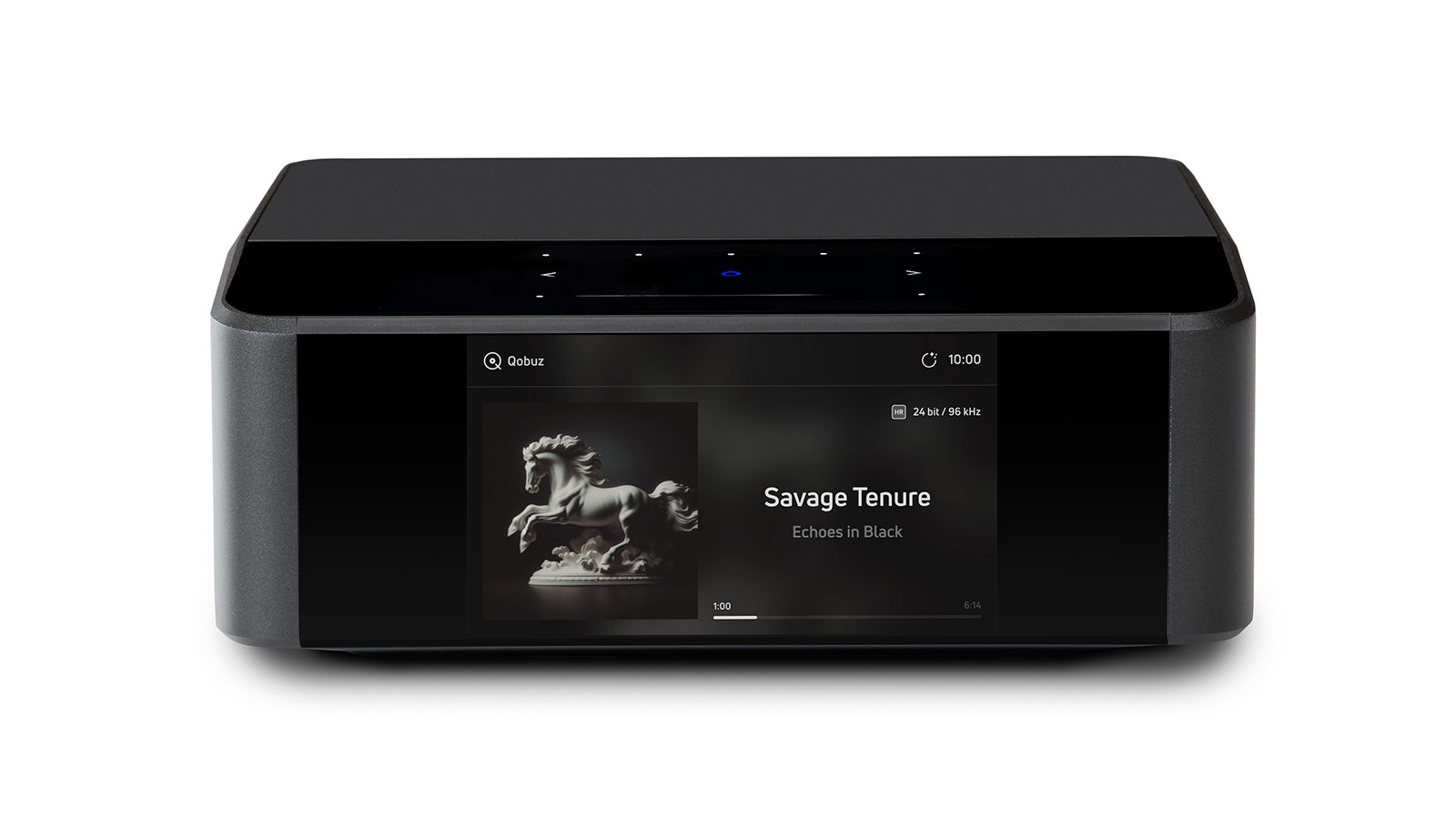
Sometimes, the arrival of a review product can trigger a keen feeling of déjà vu. I was treated to an incredibly potent dose when unboxing the Cambridge Audio EXA100 amp and EXN100 streamer from their boxes. In relatively recent history, I have reviewed both the CXN100 streamer and the CXA81 MkII amplifier from the company and confronted with the EX-devices, it is hard not to jump to the immediate conclusion that the company has sprayed the centre section black and doubled the price of each box. 

Naturally, Cambridge Audio is reasonably insistent that this is not the case. The EX models are best seen as gently enhancing the functionality of the CX devices while adding some of the engineering found in the range-topping Edge models. As the complex and elegant casework of the Edge models accounts for a significant part of their cost, it is logical that Cambridge Audio has elected to beef up the more affordable casework instead of trying to simplify an Edge. 

Similarities

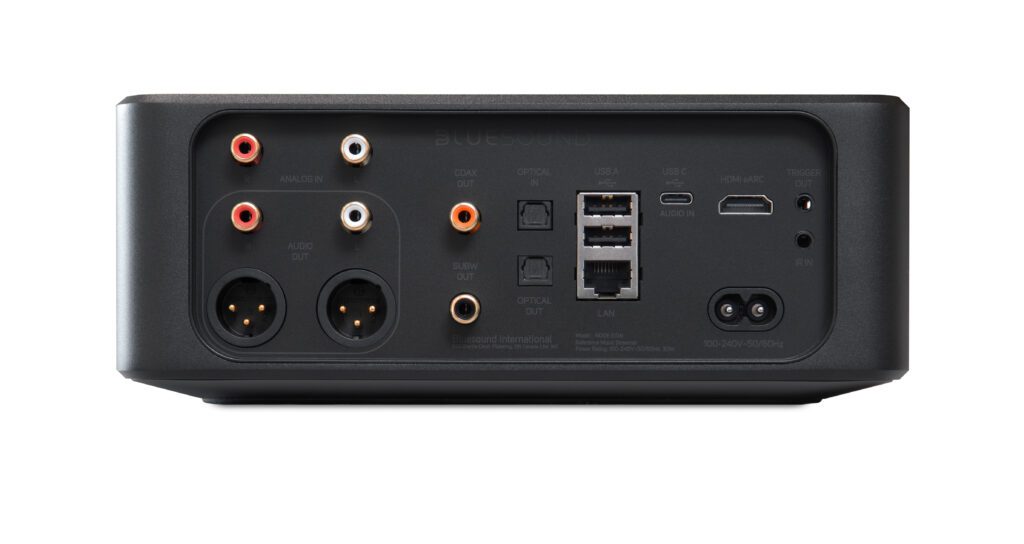
Even allowing for this, the similarities between the EXA100 amp and the CXA81 MkII are more than skin-deep. The significant spread of inputs are identical. You get a single XLR input supported by three RCA inputs and another RCA input shared over input 1 with the XLR connection. There are separate stereo pre-outs and a mono subwoofer out. This is partnered with a digital board built around an ES9018K2M DAC. This further boosts connectivity with two optical, coaxial, and USB B inputs, and it supports Apt X HD Bluetooth. Maximum sample rate handling is via USB and extends to 384kHz PCM and DSD 256. 

The only alteration that the EXA100 makes over the cheaper amp is a good one. An HDMI eARC connection joins the digital board, making integrating it with a TV much more manageable. Moreover, this is an excellent implementation of HDMI ARC too. The EXA100 has fired up every time the TV has synced perfectly, regardless of the input it was powered down in, and then returned to standby when the screen was powered down.

This might sound trivial, but you would be surprised how many devices cannot do it. I also genuinely appreciate that the front panel has a direct input selection for every input mirrored on the remote handset, which controls the streamer. The trend for amps to rely on an input cycle at the point where they are gaining more inputs is a genuinely frustrating one, and this little detail makes the Cambridge Audio much more pleasant to use daily. 

Differences

The differences in the amplifier section itself are not night and day, but they are more apparent. The circuit still adapts the CXA81 MkII, but the power rises to 100 watts into eight ohms and 155 watts into four. This is a similar output to the Edge A integrated but uses an elaborate arrangement of counterwound transformers and can double its output into 4 ohms. Cambridge Audio has gone through the circuit from front to back and improved components where appropriate. Peer through the top panel, and you can see that the internals are altogether burlier than the CXA81 MkII.

The EXN100 follows a similar process. It is an evolved CXN100 and takes the form of a streaming preamp with 100-step volume control that acts in the digital domain instead of the analogue unit in the Edge NQ. Cambridge Audio has a strong track record with this type of streamer, dating back to the original Stream Magic 6 released over a decade ago. Like the CXN100, this uses an ESS ES9028Q2M DAC and, as well as wired and wireless networking, it can connect to external devices via a USB-B, optical and coaxial digital input sample rate handling is 768kHz PCM and DSD512. The sole addition to the connectivity is another HDMI ARC input. This works as well as the one on the amp but instead exemplifies how much connectivity overlap these two devices have.

Unchanged Magic

Something else that is unchanged is the 4th generation Stream Magic control app, but this is rather more of a good thing. Stream Magic eschews widgets for a level of carefully refined real-world usability that makes many other amps feel a bit broken. In addition to rendering a local library, you get Tidal, Qobuz, Spotify, and Deezer support, an excellent internet radio implementation and AirPlay2 and Chromecast support to cover getting other content to the streamer. The EXN100 is also fully compatible with Roon as well should you wish. 

The EXN100 does a very reasonable job of justifying its existence as a standalone streamer, and it is perfectly specified to partner up with an entirely analogue integrated amp or connect directly to a power amp or pair of active speakers. What is slightly harder to justify is pairing it with the ‘matching’ amp. The EXA100 only needs a streaming interface to become a completely self-contained device, and I can see a few people baulking at the amount of doubled-up hardware in the matching streamer and choosing something more uncomplicated for the task. 

Looking good together

The two units do look very good together, though. While I will stand by my comments that the EX models look very similar to the CX units, crucially, they feel somewhat different. The casework is rather more substantial, and the points of contact, like the control knobs, have been beefed up and feel nicer as a result. The larger display of the EXN also makes more difference than I thought it might. The black strake on each unit has the unexpected benefit of making the EX models sit more happily with black devices than with the exclusively grey CX and Edge models. The build standard is also entirely in keeping with the competition at the asking price. 

I initially connected the EX devices up as a pair. I employed a pair of DALI Rubikore 2 speakers that I was thoroughly acclimatised to in the listening space and represented a price equivalent option. It didn’t take much time to realise that, in spite of their physical similarity to the CX line, there is rather more Edge in the sound of the new models. I’ve lived with an Edge A as a test amp for many years now, and it has a presentational style that I’d become very fond of at that time. EXA100 brings a significant chunk of it into its performance, too. 

Lively neutrality

This identity might best be summarised as ‘lively neutrality.’ As a duo, the EX units will not immediately grab you with the rhythmic urgency that some other devices at the price can… but no less importantly, you won’t sit there thinking they sound slow or confused. Then, after an hour or so, you can ask them to get stuck into A Certain Ratio’s ACR Loco [Mute], and there isn’t a single rhythm, beat or time signature on the album; and this being ACR, there are plenty, that the Cambridge Audio doesn’t get exactly right.

The phrase that pops up in my notes is ‘unforced intensity’; it is the closest summation I can get to what these two units do. They are perfectly content to go like the clappers. They simply avoid sounding frenetic as they do it.

Rhythmic brilliance

This rhythmic brilliance is partnered with a genuinely excellent tonal balance. When you ask for something that genuinely warrants the term ‘Audiophile’ like Ray LaMontagne’s Monovision [RCA], the experience is as gratifying as you would hope. The EX Duo opens the recordings into a gorgeous, three-dimensional experience anchored by LaMontagne’s lovely vocals, which sound believable and tangible. That same unforced feeling is manifested in the absence of emphasis on any part of the frequency response, which means you can focus on the performance as a whole.

The clever bit is that when you are done playing nice, you can dig out A Happy Medium by Sheafs [Modern Sky], and the result is still tremendously enjoyable. This is a congested, shouty mess of an album (although it still would be even if it were immaculately recorded). Still, the Cambridge Audios apply enough of their ability to soften and open out recordings to make the experience easier to listen to. Crucially, they don’t use so much that the intensity of the music is lost. If your collection is ‘a bit of everything’, there is an ability to make it all sound right that even some costly devices I’ve tested cannot match. With any given corner of that collection, there will always be a rival device that will play it slightly better, but pretty much everything will wilt against the sheer all-around ability of the EX units. 

The catch

The catch is that you can dispense with the EXN100 altogether, select a USB transport for the USB input of the EXA100 and experience much the same thing. Is the EXN better than the digital board in the EXA? Yes… but probably not enough to distract me from the vast amount of money I had just saved in ‘making do’ with the amp on its own. I brought the amp downstairs for another testing phase, connected the USB output from a Roon Nucleus, and ran the duo with a pair of Neat Petite Classics. The sound retained the same easy-going joyfulness that was present in both units. It’s very hard to look past how good the EXA100 is on its own. 

This would be bad news for the EXN100 if precisely the same thing didn’t apply to its solo performance. Shorn of the integrated, I connected up a Chord Electronics TToby power amplifier, and the resulting system was no less satisfying to listen to. The completeness of the digital inputs on the EXN100 that leave it feeling somewhat doubled up when placed with the amplifier is also its saving grace when used on its own. Suppose you have treated yourself to something like a Musical Fidelity A1. In that case, the EXN100 will supply you with every modern connection that the amp lacks while ensuring that nothing of the addictive presentation of the amp is in any way impinged by the Cambridge Audio. The EXN100 is nigh on a perfect digital source… only not perhaps for the ‘matching’ amplifier. 

No accident

The more time I have spent with them, the less I am inclined to believe this is an accident. I’m sure Cambridge Audio and its dealers are aware that amplifiers specified, like the EXA100 do not generally have much in the way of digital sources connected to them. Indeed, not using the EXN via the balanced input freed it up to be tested with the absurdly talented iFI ZEN Phono 3 using that connection with a Technics SL-1300G, and perfect the combination was, too. By specifying the EXN100 as they have, though, they’ve ensured that it is likely to be as successful as a standalone device as the amp. Whether a transport version of the EXN, keeping the aesthetics and interface but only having digital outputs, might be a worthwhile addition is one for Cambridge Audio to mull over in due course.

EXN rear

They don’t need to rush to decide though because whatever my slight reservations about the overlap in functionality, it doesn’t prevent these two products being absolutely phenomenal devices in their respective categories. However much they might look like their more affordable CX brethren, the EX models bring enough of the brilliance of the Edge devices down to a more affordable price as to be very special indeed. The Cambridge Audio EXA100 and EXN100 might still result in a feeling of déjà vu but when you have spent some time with them you might be surprised that feeling comes from above rather than below. 

Technical specifications

EXA100 

  • Power Output 100W RMS into 8 Ohms @ <1%THD+N, 155W RMS into 4 Ohms @ 1kHz <1%THD+N
  • DAC ES9018K2M
  • Frequency Response <3Hz – >40kHz +/-1dB
  • Analogue Inputs 4x RCA 1x XLR
  • Digital Inputs 2x optical, 1 x coax, 1x USB-B, 1x HDMI eARC
  • Bluetooth 5.0 aptX HD
  • Headphone Output
  • Subwoofer Output
  • THD (Unweighted) <0.002% 1kHz at 80% of rated power (8 Ohms) | <0.02% 20Hz – 20kHz at 80% of rated power
  • S/N Ratio (REF 1W) >91 dB
  • Crosstalk @1kHz >90
  • Dimensions (W x H x D): 115 x 430 x 341mm 
  • Weight: 12.8kg 
  • Price: £1,999, £2,199, €2,199

EXN100 

  • DAC ESS ES9028Q2M
  • Display Screen 4.76” IPS TFT – 1280 x 569
  • Digital inputs 1x optical, 1x coaxial, 1x USB-B 1x HDMI eARC
  • Bluetooth 5.0 with aptX HD
  • Analogue Outputs 1x RCA 1x XLR
  • Digital outputs 1x coax 1x optical
  • PCM up to 32-bit 768kHz, DSD up to x512 File system support FAT32, NTFS, Ext2/3/4, 
  • Roon Ready
  • Audio Formats ALAC, WAV, FLAC, AIFF, DSD (x512), WMA, MP3, AAC, HE AAC, AAC+, OGG Vorbis
  • THD @ 1kHz 0dBFs < 0.0005 %
  • Frequency Response 20Hz-20kHz +/- 0.1dB
  • Crosstalk @1kHz < -120dB
  • Signal to Noise Ratio (Ref 1W) > 120dBr
  • Dimensions (W x H x D) 430 x 90 x 305mm
  • Weight 4.1kg
  • Price: £1,599, $1,799, €1,799

Manufacturer

Cambridge Audio

www.cambridgeaudio.com

+44(0)207 940 2200

More from Cambridge Audio

Back to Reviews

Antipodes Audio Oladra

Do you remember that scene from The Shining? The one where the late Shelley Duvall discovers the “All Work and No Play” contents of Jack Nicholson’s ‘novel’? My listening notes for the Antipodes Audio Oladra music server were like those typed pages. They kept returning to one phrase: It’s about time!

As the name suggests, Antipodes Audio is from the other side of the planet. The company comes from Otaki on the North Island of New Zealand. This is some 45 miles from the capital, Wellington. Antipodes Audio is an overnight sensation in the high-end audio world. And, as with any overnight sensation, that’s based on more than 20 years of hard work. The brand has been working on computer audio since 2009 and made its first commercially available server two years later. It also operates a high-end distribution agency – Emotion Audio – and an on-site demonstration facility. This is not just a side hustle for a manufacturer. Antipodes Audio exposes itself constantly to the crucible of real-world listeners. No ivory tower for this brand.

Two houses…

Forgive the skewering of English grammar, but the Oladra is Antipodes Audio’s flagship servers. The singular/plural clash is deliberate because the Oladra is two music server-side products in one elegant box. The machined alloy case houses a server computer and a player computer. Chassis aside, these computers share little more than a power inlet. Both run on a Linux computer platform, but with custom code for their task. This means the Antipodes Audio Oladra performs its server duties fast and reliably. Meanwhile, the player presents the rest of your system with the best possible music source. 

‘Music server’ is not a high-pressure activity for a computer. There’s no call for an enterprise-grade device receiving thousands of file requests every second. But ‘music server’ is a specialist activity. Separating tasks this way takes some heavy lifting from the player section, moving the needle from ‘worrying about the occasional drop-out’ to ‘maximising sonic performance’.

You want options?

A music server – especially one that neatly divides between ‘server’ and ‘player’ – needs to be flexible. This is where the Emotion Audio part comes in very handy. Distributing DACs from brands such as Aavik, Ideon, and MSB (and others) means Antipodes Audio knows – first-hand – that a case-by-case installation will outperform a more uniform approach. For Oladra, Antipodes Audio features both Server (core) and Player (endpoint) applications for Squeeze (now known as ‘Lyrion’), Roon and HQPlayer. It also includes a range of DLNA-type music servers, such as MinimServer, and MiniDLNA and Lyrion Media Server, which can be paired with MPD (a DLNA player). Oladra is JPlay certified. Any of these server apps can be streamed to compatible third-party endpoints. There’s even support for SONOS or PLEX.

All these options are accessible and configurable through the ‘AMS Orchestration layer’, an online dashboard for Antipodes Audio products on that local network. This flexibility of ‘back office’ core and endpoint options mean you can tailor your Oladra to suit your system perfectly. For example, someone using a Linn DS product might gravitate toward MinimServer, or a combination of MinimServer and MPD, while a dCS user might opt for LMS/Squeezeserver with Roon or Jplay (and maybe dCS Mosaic, which works exceptionally well with the Antipodes Audio system).

An advantage to the two-computer concept begins to emerge here. Sometimes, the one-hit solution isn’t the best way of doing things. For example, while there is near-universal love for Roon’s endpoint software, some prefer it with another server software. That’s hard to do when using a combination of server and player. By using two hardware platforms, Oladra is fine-tuned for you and your system. 

Rip and store

The AMS dashboard also allows provision for bit-perfect ripping of discs. Using a third-party USB-based drive plugged into the player’s rear, the server will do all the usual tasks of cover trawling and metadata population. As a bit-perfect ripper, this doesn’t allow real-time disc replay. It can take a long time to work through a disc too, but the results are worth the effort. Yes, many think that the ship has sailed and that Qobuz and Tidal are the way forward. And yes, most server users who claim Qobuz and Tidal are the way forward came to that conclusion after ripping about a dozen discs and deciding life is too short to carry on. But the Antipodes Audio Oladra is not most servers. Playing back those ripped discs is such a joy, you find yourself seeking out CDs to rip. 

Secret pleasures

This is one of Oladra’s secret pleasures. CDs are in the same place LPs were just before the start of the vinyl revival. Back in the late 2000s, LPs were cheap. If you could get one, the LP could be bought for peanuts, and the CD would still command premium prices. Now, things are very different. CDs are remaindered, sold at a discount and fill up the shelves of charity shops and thrift stores worldwide. You can come home with a suitcase full of CDs for less than the cost of a decent dinner. Today, that same ‘decent dinner’ would net you a handful of LPs. CD is so cheap because streaming has ‘replaced’ CD… except when you rip them to your Oladra and discover just how much music CD replay left hidden in the shadows.

Storing those tracks gives you a choice of NAS drives on your local network or three rear slots for SSD storage. These narrow 2.5” SATA slots allow the user to hold up to 24TB of music across the trio of enterprise-grade solid-state drives. They are not hot-swappable, meaning if, in the unlikely event that one fails or 24TB isn’t enough, you must power down the Oladra and change drives. On the other hand, having 24TB of storage in the best possible performance means a whole music collection for most people, even if stored in uncompressed WAV files. It’s only if you have more than 5,700 SACD albums stored in uncompressed form that you might begin to need to consider other options.

It’s about time

In listening to the Antipodes Audio Oladra, it exposed a part of music that we used to take for granted when LP and tape were uppermost; timing. While the Oladra is excellent at all the usual things we come to expect from digital audio (detail, dynamic range, tonal accuracy), it’s the ability to present the music in a temporally-ordered fashion that was something more akin to good analogue than the best in digital… until now. And that hits you seconds into the first piece of music you play. It’s a ‘hang on a moment’ part, as that track gets under your skin.

You don’t just hear the recording on a cerebral level; you feel it as if it it’s there with you, temporally precise and focused the way nothing else can. That degree of precision to timing is more atavistic that descriptive; it’s like the difference between hearing a live band and a recording; you know instinctively that it’s a guitar, not a recording of a guitar… and the Oladra gets you closer to the original than most.

The hardest part of dealing with the Antipodes Audio Oladra is defining why it’s so good. It’s not simply about the usual audio bits; those test recordings came and went perfectly, but they were quickly proving uninformative; everything you want the music to do from an audiophile perspective, it does well, sending an uncolored, detailed, articulate and precise sound to your DAC. Your DAC becoming the main arbiter of performance given what its fed is as good as it gets. But you soon abandon those tracks just to play things for sheer enjoyment. Whether it was Chase & Status banging out some drum ‘n’ bass or Louis Armstrong playing cornet almost a century ago, it’s all about the feels, and that – above all things – is what Oladra does that others don’t!

No, it’s about time

The ability to set aside what we thought were intrinsic limitations of digital makes the Antipodes Audio Oladra something more than a music server. It makes it a time machine. You play those records from your past as if it’s the first time you heard them. You then start to appreciate music from other people’s pasts in the same way. I got more out of 1950s do-wop bands from the Antipodes Audio Oladra than I have experienced before, and they weren’t my memories, because I wasn’t around when they happened. But tracks you dig up from the past sound fresh and new. Even your own well-worn tracks like ‘Hurricane’ by Bob Dylan sound like the first time you heard them. And that makes you remember what you were doing then, too. It’s an uncanny experience.

I risk being burned at the stake for saying this, but the Oladra makes the need to play LP become more of an ‘option’ and less of a ‘mandatory requirement.’ You don’t get the same physical contact with a digital file as with an LP. Still, in sheer musical terms, the experience of extracting musical enjoyment is at least on par with the best you can get from LP, digital discs, or even open-reel tape. I won’t labour this point as I can already hear an angry mob forming, and I’m allergic to pitchforks. Regardless, it shows how far things have moved forward with the Antipodes Audio Oladra.

The price of admission – even if you look to the Kala products rather than the Oladra – is steep until you hear what it can do. But that throws down a gauntlet for other server-side companies. How close to the Antipodes Audio Oladra’s performance can you attain at lower price points? For now, this is a question left out in the open, but the challenge is there. I doubt Oladra’s performance will be easy to replicate without the result having a similar price tag, simply because this is a lot more than a couple of computers and some SSDs in a box. But good digital audio at all levels needs a game-raiser, and the Antipodes Audio Oladra is just that.

Finally, there’s a nod to be made to Ivor Tiefenbrun of Linn Products. Half a century ago, he tore up the rule book. He ignored the received wisdom to stress the importance of the source component. To use a computing term, “garbage in, garbage out”. In hi-fi terms, the quality of the source is the defining and limiting factor in a good audio system. Over the years, that message has been diluted somewhat thanks to outstanding audio electronics and loudspeakers. However, the Antipodes Audio Oladra proves Ivor was on to something. It still holds to this day. 

Put it this way: I would rather have Oladra running a more modest system than have absolute top-end audio driven by a more off-the-shelf server. Little wonder then that the makers of those top-end components have been quietly shifting to the Oladra as part of their front-end electronics.

No, really, it’s about time

If I repeat that ‘it’s about time’ phrase, it’s for a reason. Three reasons in fact; two of which have been explained. But it is about time that the high-end took streaming seriously. And the Antipodes Audio Oladra takes high-end streaming seriously. It delivers the performance that uncompromising high-enders demand of their other formats. This means online, especially locally stored computer-based music, finally stands for something more than ‘music discovery’.

Let’s not ignore the importance of Qobuz, Tidal, and even Spotify in helping us find new music. Roon’s functionality makes that great, too. But once we’ve ‘discovered’ a piece of music, genre or musician, that’s the time when the Antipodes Audio Oladra steps up. You will want to dive deep into that music. You’ll also want to do it from local storage because it sounds so genuinely fantastic. It’s also one of the few servers that deserves to be on show because it looks as good as it sounds.

Quad Electrostatics, Linn LP12s, Krell KSA-50s, Wilson WATT/Puppys and Nordost Odin. A select group of products that came to define audio performance. They were—and in many cases, still are—a standard by which musical performance in the home is measured. The Antipodes Audio Oladra joins that select group. Audio has taken a big step forward here. 

Technical specifications

  • Type: Dedicated music server player
  • Inputs: 2x Ethernet (RJ45), 2x USB-A
  • Outputs: 1x USB-A, Coaxial/RCA S/PDIF, Coaxial/BNC S/PDIF, optical S/PDIF, 1x AES3 XLR, 2x I2S (HDMI, RJ45)
  • Storage: 3-Bay SSD user-installable SSD Slide-Ins up to 24TB
  • Formats supported: 
  • Ethernet, USB 2.0; PCM to 32/768, DoP to DSD256, native DSD to DSD512. 
  • AES3; PCM to 24/192 and DoP to DSD64
  • S/PDIF; PCM to 24/192 and DoP to DSD64
  • I2S; PCM to 32/384, DoP to DSD256, and Native DSD to DSD512. 
  • Finish: anodised silver or black, with polished stainless steel and chrome highlights
  • Dimensions (WxHxD): 44.5x8x40cm
  • Weight: 21kg
  • Price: £28,888

Manufacturer

Antipodes Audio

www.antipodes.audio

UK distributor

Absolute Sounds

www.absolutesounds.com

+44(0)20 8971 3909

Back to Reviews

Thrax Audio Sirens

Quietly, Bulgarian hi-fi company Thrax Audio has transformed. No longer just a maker of high-end audio electronics, Thrax has become a company providing complete audiophile solutions. The brand focuses on outstanding preamps, power amplifiers, and integrated amplifiers. And models like the Thrax Audio Sirens stand-mount loudspeaker show its adeptness in the audio builder’s art.

Sirens follow the successful Lyra two-way, three-driver rear-ported stand-mount, the first loudspeaker from Thrax Audio. The plan was to make the Sirens behave entirely consistent with the D’Appolito-based mid-tweeter-mid Lyra, but in a smaller, more conventional two-driver, two-way rear-ported design. That plan could only be achieved due to developments in drive unit technology. It worked, and the Sirens’ one mid-bass unit delivers virtually the same performance as a pair of custom magnesium cone mid-woofers. That development is the introduction of the PuriFi drive units, which are transforming the performance of many high-end loudspeakers worldwide.

Sultry and moistened

Calling your loudspeakers ‘Sirens’ is a tough call. It calls up images of half-woman, half-bird creatures that lured Ancient Greek seafarers to their deaths with their alluring voices. Conversely, you are reminded of emergency alarm systems, blaring warnings of impending air raids or tsunamis. I prefer to think of them as the sultry and moistened washerwomen from the Coen brothers’ movie from 2000, O Brother, Where Art Thou? Their siren song – ‘Go To Sleep You Little Baby’ written for the film and performed by Emmylou Harris, Gillian Welch and Alison Krauss – was one of the high points in a movie filled with high points. And like that lullaby, the Sirens call – the Thrax one – stays with you. 

Like the Thrax Audio Sirens’ bigger, older Lyra brother, the tweeter is a 25mm ring-diaphragm high-frequency unit. It is developed by the German professional audio brand BMS. This comparatively unusual design features a neodymium magnet in a deep, elliptical, solid aluminium horn. This horn is not an arbitrary shape but results from years of research in Thrax’s native Bulgaria. 

The driver choice inside that horn is also the result of extensive listening tests by Thrax’s founder and chief designer, Rumen Artarski. In developing the Lyra, Artarski auditioned all other types of tweeters in various materials. He found that most fail to deliver at the lower end of their spectrum. This is a significant issue in a two-way design where the tweeter is expected to handle at least some midrange component. Artarski gets a tweeter that works well with mid/bass drivers – without adding a midrange – by using a compression tweeter with a ring diaphragm. Also, the unique waveguide shape gets over the quacking, shouty sound of horns of the past.

Win-win

A tweeter system with this degree of sophistication is only a win-win if matched with a suitably adept mid-bass. In the Lyra, that’s a pair of SEAS Excel units. These are state-of-the-art drivers… from the mid-2010s. However, driver technology has moved on, and the Siren features a single 170mm Ushindi mid-woofer from newcomer PuriFi. Launched in 2019, the PuriFi project is the brainchild of Bruno Putzeys and Lars Risbo – the brightest people in any room not containing Nobel laureates – and makes Class D amplifier modules and Ushindi transducers. While the most visible difference between PuriFi drivers and others is the unusual ‘inny-outy’ corrugated surround, it’s a tabula rasa design intended to improve linearity and lower distortion at any volume level. The result is a long-throw cone with a large, innovative, and extraordinarily linear motor system. It, too, is the product of years of research.

The PuriFi driver has become a panacea in European high-end loudspeaker circles. However, it cannot be a direct swap for an existing drive unit. A driver with significantly lower distortion, superior linearity and power handling will show up even the most minor idiosyncrasies elsewhere in the loudspeaker design. Such a ‘no quarter’ drive unit tests the mettle of design and designer alike; many are found wanting. Thrax wasn’t! The Thrax Audio Sirens’ thick aluminium baffles front and rear, which can also be seen in the Lyra, greatly help. However, the rest of the cabinet is now cross-braced birch ply, wrapped in leather. At the rear are a small, slightly flared rear port, a single pair of multi-way Aeco binding posts, and 14 large Allen bolts to hold the loudspeaker together.

Well constructed

Inside the Thrax Audio Sirens is a well-constructed crossover network using some of the best components. However, as these are sealed and potted (to limit the adverse effects of vibration), we have to assume that the crossover does feature wax-impregnated foil-wound inductors and silver foil capacitors on the tweeter. Its internal wiring is all custom OCC copper.

The Thrax Audio Sirens are best used on high-mass 24” stands, rigidly floor-coupled, kept away from walls, and with a mild-toe-in. They also need to be very well-fed. Since Thrax Audio offers several amplifiers capable of handling that task, it’s a good starting point. Beyond that, however, the loudspeaker is an 87dB efficient design with a pleasingly flat four-ohm impedance and 250W power handling. In other words, you could use everything from a low-power single-ended triode design to a powerhouse of an amplifier without a problem. Thanks to its headroom, the amp slightly favours the meatier end of the market, so quality and quantity would be a good choice. They aren’t unduly fussy, though.

This sounds like the worst kind of faint praise, but it isn’t. The Thrax Audio Sirens are some of the most benign-sounding loudspeakers in their category. Everything has great poise and balance. They make music sound effortless and – fed by a large amplifier – far more dynamic than you would expect from a loudspeaker of this size and volume. They fill out a room far more significantly than similarly-sized stand-mounts – they give many floorstanders a good run for the money – and are surprisingly ‘volume agnostic’ – you can play them at Whispering Around Midnight levels or at head-in-the-bass-bin-at-a-Mogwai-gig levels (well, almost; the Mogwai thing would end in severe hearing damage, but you get my drift).

Benign

This benign nature is its greatest boon, but listeners must be entirely new to audio or willing to reset their standards. Over the years, those who have become accustomed to the distortions, colorations, and limitations of conventional ‘cone and dome’ loudspeakers might find them hard to overcome. This is especially true for those of us who listen to a lot of live music through public address systems – even excellent ones. There will be a few minutes of wondering where all the fireworks went before they realise they are precisely where they should be. They are on the recording.

I noticed this by playing two of my regular test recordings back-to-back: ‘Polly Ann’s Hammer’ by Our Native Daughters from Songs of Our Native Daughters [Smithsonian Folkways] and ‘Chameleon’ from Trentemøller [The Last Resort, Poker Flat]. I tend not to mention the Our Native Daughters album too much because I use the first track, ‘Black Myself,’ mainly as a ‘palette cleanser’ to re-orient myself to the speakers in the room. However, it stayed on this time, and the bluegrass-esque track six is all-acoustic; the only electronics are in the recording chain. The Trentemøller track is a total contrast; every sound is synthesised and processed. 

Distinct differences

On the Thrax Audio Sirens, it wasn’t just that the differences between the two were distinct; the intellectual and even philosophical differences between them were more marked. The acoustic Our Native Daughters track didn’t come with any extra padding or added warmth; it just sounded like a blend of blues, spiritual, and bluegrass, with all the intensity and power that track has. Trentemøller lost none of its drive and energy – and had the sort of bass depth unexpected from a box this size – but the absence of speaker distortion and lack of the cabinet joining in for a spot of bass boost took longer to parse than the acoustic track.

That said, the acclimatisation process took about a minute or so, by which time the atavistic fear of ‘big things about to eat you’ took hold. This is – and should be – a scary track, full of deep noises that hit you in the ‘fight or flight’ part of your brainstem. However, having played it so many times, most of the digits have worn flat, and that feeling is held in check. Not this time, and as it now only comes out to scare with huge, full-range loudspeakers, that is one hell of a feat of clarity on the Sirens’ part.

Song to the Siren

I couldn’t resist playing Larry Beckett and Tim Buckley’s ‘Song to the Siren’ but chose the This Mortal Coil version [It’ll End In Tears, 4AD] from 1983 rather than the Tim Buckley original from 1970. That one hit me in the feels; Elizabeth Fraser’s swooping, soaring vocals and Robin Guthrie’s guitar wizardry are atmospheric and brooding. The whole track takes on an ethereal quality that the Thrax Audio Sirens revel in.

You are immersed in a rich, dense soundstage like the musical equivalent of a dreamlike, floating world. You do feel like you are being drawn toward your fate on this track, and the Thrax loudspeakers brought that out perfectly, thanks to their absence of coloration and outstanding imagery. Notably, the track avoids the syrupy sound, a trap it often falls into. The sound is rich and sensual, but it lacks the cloudiness and stodginess that usually plague it when played on small speakers with too much upper-midrange bloom.

Not a showcase

This wasn’t the track to showcase dynamic range, although it is surprisingly good at teasing out the subtleties of phrasing and changes in instrument dynamics within a track. There’s so much going on in the mix that it’s easy to get lost in it, but you become aware of those remarkable changes in dynamics that Elizabeth Fraser is capable of. What often sounds like ‘warbling’ in many loudspeakers is presented here as an uncanny simultaneous pitch, tone, and intensity vibrato.

In more immediate dynamic range terms, I went to Rachmaninov’s Symphonic Dances [Zinman, Baltimore SO, Telarc] and the force of the orchestra is presented exceptionally well. The Thrax Audio Sirens cope with the pianissimo woodwinds, and the fortissimo percussion-led orchestra swells with equal aplomb. Once again, this gets close to being a magic trick when played from a loudspeaker of this size; close your eyes and there’s a three-way floorstander in the room.

Everything, everywhere, all at once

I felt like I had to cram as much music as possible into the Thrax Audio Sirens. Partly, that was to test them, but mostly because I wanted to hear my music unimpeded by the loudspeakers. Of course, it’s possible to get loudspeakers that do something similar and even loudspeakers that do more than the Sirens. But you’ll pay handsomely in both size and price. And in that cramming music into the Sirens, I found a final joy to them; they are remarkably adept at playing recordings at the level they should be played. This is long forgotten in audio, but some pieces of music are best played loud [I’m looking at you, Infected Mushroom], and some are best played quietly [Bill Evans]. You’ll find each recording’s Goldilocks point quickly with the Sirens.

Of course, that also requires a loudspeaker that can play loudly and quietly without strain or changes in tonality. That’s where the joy of the Sirens shines through. I can play ‘End of the Road’ by said fungal band [Legend of the Black Shawarma, Infected Mushroom, Perfecto] at ear-splitting levels without the loudspeaker straining, or I could play it so quietly I could whisper over it and enjoy the track. Similarly, if I put on ‘The Pan Piper’ from Miles Davis’ Sketches of Spain [Columbia] – or especially ‘Peace Piece’ by Bill Evans [Everybody Digs Bill Evans, Riverside], I could play it at talk-over levels or a full-throated roar. However, why anyone would want to play ‘Peace Piece’ at anything beyond ‘reflective’ levels is beyond me, because the Sirens find the volume sweet spot for each record fast.

Important

The Thrax Audio Siren is an important loudspeaker. It shows what can be done with a relatively small two-way stand-mount design when the gloves are off. The effortless compression driver digs well into the midrange, and the PuriFi driver reduces distortion across the band. This combination sets the standard for this type and size of loudspeaker. It makes many of its rivals sound small and colored, and to get something better, you need a bigger loudspeaker and a bigger wallet. 

Technical specifications

  • Type: Two-way, bass-reflex stand-mount loudspeaker
  • Drivers: 1x 25mm ring-diaphragm compression tweeter, 1x 170mm PuriFi mid-woofer
  • Frequency Response: 36Hz-20kHz
  • Sensitivity: 87dB/1m/2.83V
  • Impedance: 4Ω
  • Maximum power handling: 250W
  • Finish: Anodised aluminium front and rear panels, red or black leather-wrapped cabinet
  • Dimensions (WxDxH): 21x34x34cm
  • Weight: 20kg

Price: £10,500, $13,600, €12,480 per pair

Manufacturer

Thrax Audio

www.thraxaudio.com

UK distributor

Lotus Hi-Fi

www.lotushifi.co.uk

+44(0)7887 852513

More from Thrax Audio

Back to Reviews

New Project V1-S top-of-range speaker cable from Furutech

Furutech, Japanese manufacturer of ultra-refined audio and video cable and accessories, introduces the new Project V1-S high performance speaker cable, the latest addition to the brand’s flagship Project series.

Furutech’s top-of-range Project series of cables features a host of the company’s own groundbreaking technologies and patented designs, married with the finest quality materials. Engineered with the same precision and unwavering commitment to exceptional sound quality as the Project V1 power cord, V1-L interconnect cable and V1-T tonearm cable, the new Project V1-S speaker cable promises an immersive and lifelike audio performance that caters to dedicated audiophiles and professional sound engineers alike.

At its core, the Project V1-S features a three-layer concentric combination of two of the best conductors Furutech has found for high-performance sound reproduction: the company’s own renowned silver-coated, Alpha-treated Ohno Cast Copper (OCC) conductor, along with Mitsubishi’s Ultra Crystallized High Purity Copper (DUCC) conductor, which employs one of the highest-purity oxygen-free coppers in the world.

This hybrid configuration undergoes Furutech’s unique two-stage ‘Alpha’ cryogenic and demagnetization process, designed to deliver unparalleled conductivity. The combination is then triple shielded and double insulated to ensure superb signal purity. Additionally, a specially engineered cable clamp improves grip, thus avoiding any potential distortion.

To further enhance sound reproduction, the cable incorporates Furutech’s own proprietary NCF (Nano Crystal2 Formula) technology, designed to deliver excellent damping properties and eliminate noise and interference, ensuring a remarkably quiet soundstage and an impressively transparent presentation.

Externally, the cable features a multi-layered sheath consisting of high-grade insulation and a vibration-damping layer. This construction prevents external interference, ensuring the highest quality audio transmission and minimizing signal degradation.

As you would expect, the Project V1-S includes high-performance connectors, in both spade and banana configurations. These feature non-magnetic, rhodium-plated, pure copper conductors in a one-piece construction. The connectors’ bodies and cable damping rings feature Furutech’s unique NCF Liquid Crystal Polymer Resin, which combines the company’s NCF material with high-grade nylon and fiberglass for superior damping and insulation.

With its meticulous construction and exceptional signal transmission technologies, the Project V1-S is crafted elevate your audio system to new heights and unleash the true potential of your music.

Dimensions: Cable diameter approx. 26mm; overall length approx. 2.5m.

Pricing & availability

 Furutech’s V1-S speaker cable is available now, in a standard 2.5m length, priced at £10,200 (inc. VAT).

Your first hi-fi system just got cheaper: Fell Audio’s package bundles put audiophile quality in reach

6 August 2025, Carlisle, Cumbria: Fell Audio, the disruptive British hi-fi manufacturer, is making great hi-fi even more accessible with exclusive bundle deals on its award-winning British-made Fell Amp integrated amplifier (£599). Music lovers can now pair the Fell Amp with a range of big-name loudspeakers, including KEF and Bowers & Wilkins, at significantly reduced package prices.

Fell Audio’s bundle offers, available exclusively through retail giant, Peter Tyson, online, in-store and via telesales (Peter Tyson also opened a brand new Workington shop in July), offer remarkable savings compared to purchasing components individually. Whether a newcomer to hi-fi or a seasoned enthusiast with an eye for value, Fell Audio makes building a premium quality, British-centric hi-fi system simple and affordable.

As an added bonus, all Fell Audio bundle buyers receive complimentary QED XT25 loudspeaker cables and Fell Audio RCA interconnects for a seamless, out-of-the-box setup.

To further enhance value, customers can add the acclaimed Fell Disc CD player for a special discounted price of £449 (usually £499), saving an additional £50 on the world’s most affordable British-made CD player. There’s even free next working day delivery to most regions in the UK.

Notable upgrades have been made to the fellaudio.co.uk site, too. There’s a brilliant new manufacturing page, a silver/black finish toggle switch, review badges and a ‘where to buy’ button.

Newcomers to hi-fi are reminded that Fell Audio is committed to quality, sustainability, and longevity, and backs its repairable British-made hi-fi designs with a class-leading five-year warranty.

Fell Audio bundles: https://petertyson.co.uk/brands/e-f/fell-audio/bundles

Price and availability

The Fell Disc (£499) and Fell Amp (£599) are available in the UK only (Europe to follow in 2025/26) from Peter Tyson online, in-store and via telesales, and Amazon UK (bundles not on Amazon).

DALI Rubikore 2

DALI‘s Rubikore 2 comes from the Kore. It’s been a couple of years now since DALI whipped the necessarily large covers off its flagship ‘Kore’ loudspeaker. Forward-thinking and uncompromised in its engineering, suitably stratospheric in its pricing and (to be frank) with looks only a mother could love, it served – as so many flagship designs from so many loudspeaker brands do – as a design exercise, a statement of intent, and a test-bed for new technologies. Technologies that might hopefully make their way down to loudspeakers designed to compete in the real world.

Yes, 2023’s Epikore 11 utilises some core Kore technologies. Although it’s roughly half the price of Kore, it remains witheringly expensive. Kore’s strengths are finally available to those of us who have to work for a living. With its new Rubikore range, DALI has democratised some of these technologies to the point that the Rubikore 2 – the only stand-mounter in the five-strong range – can be had for a mere £2,299 per pair.

Rubikore or Rubicon?

Visually, there’s very little to overtly separate the DALI Rubikore 2 from 2014’s Rubicon 2 stand-mounter that this model replaces. The cabinet is a very similar 350 x 195 x 335mm (HxWxD). Its front baffle and rear panel are similarly curvy. Mind you, this is not automatically a bad thing. The Rubikore 2 is relatively good-looking in a purposeful sort of way. The standard of build and finish is impeccable. Each of the four available finishes – high gloss white, high gloss black, high gloss maroon and natural walnut – has something to recommend it in aesthetic terms. The description ‘high gloss’ has never been more appropriate or deserved.

On the curved rear of the cabinet, there are four extremely hefty speaker terminals arranged for bi-wiring or bi-amping. They can accept bare wire, spade connectors, or banana plugs. A fairly assertive ‘Continuous Flare’ bass reflex port tuned to 44Hz sits above them.

The DALI Rubikore 2 front baffle, meanwhile, features a tweeter above a mid/bass driver in the long-established manner. The soft dome tweeter, at 29mm, is unusually large for a speaker of this size. It takes inspiration from the original Kore design. This is arranged to function without the magnetic oil that’s usually present in a dome tweeter design. This oil provides both cooling and resonance damping. DALI reckons it can manage without. It cites the improved speed of coil movement and enhanced dynamic response as compelling reasons why. 

Fairly Sizeable

The mid/bass driver beneath it is, at 165mm, a fairly sizable unit too. DALI’s paper-and-wood-fibre cone material is the subject of continual development. Consequently, it has that customary rusty reddish-brown colour. This ‘Clarity Cone’ features five indentations that render it asymmetrical. This makes it more resistant to the resonances that symmetrical cones can be prone to. A potent double-magnet system backs the driver. DALI claims it better focuses the magnetic field and reduces losses. It also uses the company’s patented ‘SMC’ (soft magnetic compound) material in its motor system. This minimises the braking effects that the more commonly used iron can introduce to voice-coil movement.  

DALI-RUBIKORE-2-BLACK-HGL-PRODUCT-U-GRILL-CAM-02

It’s quite a dramatic-looking driver array. However, supplied cloth grilles hide the array if you want. That would be a shame, in my opinion – although the fact that DALI, unlike the majority of its competitors, doesn’t use magnetic fixings but rather three physical lugs to keep the grille in place spoils the un-grilled look just a little. Lug holes are never a beautiful thing.

Mundorf-fettled

So the DALI Rubikore 2 is a two-way design with a nominal impedance of 4 ohms and an ever-so-slightly tricky 87dB/W/m sensitivity. Frequency response, according to DALI, is 50Hz – 26kHz, with cross-over occurring at 2.8kHz. The crossover itself is fettled using Mundorf-sourced parts – but there’s no sign of the SMC-Kore crossover inductors that are fitted to the floorstanding Rubikore 6 and Rubikore 8 models. 

DALI-RUBIKORE-2-BLACK-HGL-PRODUCT-M-GRILL-CAM-02 copy

Attached to a Naim Uniti Star using QED XT40i speaker cable, positioned on a pair of Custom Design FS 104 stands and pointing dead ahead – DALI is one of those few loudspeaker brands that doesn’t suggest you toe-in its products towards your listening position – the Rubikore 2 wastes no time in setting its stall out. And what a neat, tidy and well-stocked stall it turns out to be.

No genre refused

There’s no genre of music the DALI Rubikore 2 refuse to get on with, and no recording is too rough-and-ready to be a lost cause. No matter what you listen to – and during this test I listened to everything from Arooj Aftab’s Vulture Price [New Amsterdam] and The Smile’s Wall of Eyes [XL] to Stravinsky’s The Firebird Suite (Radio Symphonie Orchester Berlin/Lorin Maazel) [Deutsche Grammophon] and Up For a Bit with the Pastels [Glass] – the Rubikore 2 are balanced, organised and non-judgemental. If you like it, they want it too.

Detail levels are high in every circumstance – and, no matter how fleeting or how deeply buried in the mix, the DALI Rubikore 2I can put the details into convincing context every time. The soundstage they create is, given the right stuff to work with, notably well-organised and considerably larger on the left/right axis than the physical boundaries of the speaker cabinets themselves. Tonality is carefully neutral. The recording is the only source of heat or suggestion of chilliness you might hear.   

Carefully managed 

Low-frequency impact is carefully managed – some competing designs will undoubtedly hit harder and with more substance, but no price-comparable alternative controls its low-end activity more carefully. Bass sounds are full-bodied, loaded with variation and straight-edged at the moment of attack – and consequently, the Rubikore 2 describe rhythms with absolute positivity and conviction. Momentum is such that recordings motor along in the most natural and unforced manner. And when push comes to shove, the DALI can summon proper bottom-end impact – but it’s always in the service of the recording, rather than to intimidate.

The opposite end of the frequency range has more than enough substance. It can balance out the undoubted brilliance and bite the DALI Rubikore 2 bring to treble sounds. There’s genuine shine and drive when a recording demands it. However, it never threatens to get out of hand thanks to proper handling. Even if you enjoy listening at reckless volumes.  

In between, the DALI communicate midrange information in a manner quite easily described as ‘lavish’. They reveal an absolute stack of information, parse it with complete confidence, and seem to understand a vocalist’s motivations completely. They’re an eloquent and expressive listen with singers of all types. Their confidence, where soundstaging is concerned, means there’s generally a pocket of space in which a vocalist can operate. This elbow-room is never at the expense of the unity of the presentation, though. There’s nothing remote or estranged about the way the Rubikore 2 positions a voice.  

Pearly Dewdrops’ Drops

The journey from the bottom of the frequency range to the top is smooth in the manner of a dewdrop – the crossover point is imperceptible and the DALI Rubikore 2 doesn’t over- or understate any area. They have the effortlessly deep-breathing dynamic potency to put significant distance between the quietest and loudest, most intense passages of a recording – always handy when Igor Stravinsky is involved. And perhaps most impressive of all is the casual, unforced and utterly direct way in which the Rubikore 2 demonstrate its command over pretty much every aspect of music-making.

Some listeners, I don’t doubt, will mistake this even-handed, poised and uncolored presentation for a lack of passion or engagement. Some listeners will want a bit more bang for their buck, quite literally. They’re by no means an undemonstrative listen, these DALI Rubikore 2. Still, they aren’t about to demean themselves with unwarranted low-frequency activity or unnecessary forcefulness. What they are about is as faithful a rendition of music, and as full an explanation as possible of the electronics that are driving them, as possible. This is, for most listeners, as much as they might realistically hope for. Or, at least, that’s how it seems to me. 

Technical specifications

  • Type: Two-way; bass reflex port stand-mount loudspeaker
  • Driver complement: 1 x 29mm soft-dome tweeter; 165mm ‘Clarity Cone’ paper/wood pulp mid/bass driver
  • Frequency response: 50Hz – 26kHz 
  • Crossover frequency: 2.8kHz  
  • Impedance: 4 Ohms nominal
  • Sensitivity: 87dB/W/m
  • Dimensions (HxWxD): 350 x 195 x 335mm
  • Weight: 9.5kg/each
  • Finishes: High gloss white; high gloss black; high gloss maroon; natural walnut
  • Price: £2,299, $2,500, €2,598 per pair

Manufacturer

DALI

www.dali-speakers.com

+44(0)1462 337 320

More from DALI

Back to Reviews

Chord Company PowerHAUS P6

Electrical generation and distribution in the UK are generally good. However, the quality and robustness of the equipment connected to the UK supply can vary. What is needed for delicate hi-fi systems is consumer equipment made to professional standards. That’s where products like Chord Company’s PowerHAUS P6 come in. 

The P6 evolved from the custom distribution boards that Chord Company has been building for its use at hi-fi shows and internal demonstration rooms since the mid-1980s. It has experimented with numerous wiring techniques, filters, shields, and conductors in various multi-stranded and solid-core wire gauges. Put another way, the P6 draws on four decades of iterative product development. The ‘real world’ problems that had to be identified and solved would, it would seem, also apply to the domestic environment.

As its name suggests, the Chord Company PowerHAUS P6 has six sockets. This number should be sufficient for most high-grade hi-fi systems. It’s enough for a pre- or power amp, turntable, phono stage, CD transport, and DAC, for example.

Faultless build

One cannot fault the Chord Company PowerHAUS P6 for build quality. If you’ve recently handled a cheap multiway plastic extension lead, here’s a product to restore your confidence in British industry. On its solidly constructed two-piece metal chassis are two sets of three 13-amp sockets. There is a version with Schuko sockets for EU users and there will likely be an Aus/NZ version, but no sign of a US version. These are separated amidships by the IEC mains input socket and a grounding post. Used sensibly, the latter can help you identify and ‘break’ the earth loops that can cause audible hum. Chord Company also told us that “some people with sprawling AV systems can benefit” from the casework earthing. 

It’s pared back to basics, though. You don’t even get a master switch. Chord Company, I was told, “doesn’t like serial filters and instead, focuses on keeping impedances as low as possible”.  The latter design goal helps to, for example, reduce wasteful voltage drops (and unwanted heat generation) with heavy loads – such as big, powerful amplifiers. The chances of distorting the all-important sinusoidal mains waveform are also reduced. 

C13, C19… go

Instead of the C13 IEC connector (rated to 13 amps, hence the name), Chord Company has specified the larger, higher-current C19 variety (up to 20 amps, depending on voltage) for mains input. C19 connectors aren’t standard in the UK, at least not in consumer products, although I have seen them fitted to some ‘muscle amps’. Thankfully, Chord Company supplies a two-metre C19 mains lead to ‘get you going’. This can be upgraded later, possibly to a Chord Company Clearway.

The Chord Company PowerHAUS P6’s nicely finished body is capped at either end with tough plastic mouldings. These are fitted on the underside with rubber feet to prevent the P6 from sliding around. Chord Company says that it’s suitable for an assortment of surfaces, including wood, carpet, tiles and the shelves of hi-fi racks. For installation of a more permanent nature, slotted recesses for mounting have been stamped into the rear of the body. These are for wall- or stand-mounting. 

A peek inside the Chord Company PowerHAUS P6 reveals neat construction. The heavy-gauge wiring looms are the product of hand assembly – no cheap brass strips here! The six ‘carefully chosen’ mains sockets that they interconnect are individual components. If one is damaged or develops a fault, replacement should be possible. This is much better than throwing away the entire unit – hardly a desirable outcome at £600 a pop! A lifetime warranty demonstrates Chord Company’s faith in its product. 

Ferrites – nein danke!

In keeping with Chord Company’s philosophy, no ferrites or other RFI-reduction measures were visible, nor were there any ‘noisy neons’. Chord does, however, claim that P6 employs some of the GroundARAY and PowerARAY mains noise-reduction techniques used by some of its more expensive products. Sensibly, Chord Company recommends keeping mains cables as far away as possible from those of the signal-carrying variety.

Over an extended period, I tried the P6 with two very different systems. There was also a ‘vintage’ one, which included a Dunlop Systemdek IIXE/900 turntable with Alphason Opal tonearm and Denon DL304 MC cartridge feeding an Audiolab 8000A integrated amplifier. The first of the more modern outfits consisted of a Cambridge Edge NQ streamer/preamp, Edge W power amp and Quadral Aurum Wotan VIII floorstanders. Vinyl replay here involved the Systemdek used above, with a Pro-Ject Phono Box S2 Ultra preamp to bring the Denon’s tiny signals up to line level. Systemdek aside, all these components are CE-compliant. Despite the considerable gain needed for MC cartridges, mains-borne noise was negligible.

Also pressed into service was a highly revealing (bordering on unforgiving!) digital arrangement built around a Callia headphone DAC from the highly respected pro-audio manufacturer Prism Audio. This drove Focal Utopia headphones, while sources included a Cambridge CXN streamer and Arcam CD transport. This second system could be transported to different rooms to gauge the effects of house wiring. The P6’s six sensibly spaced mains outlets proved ample in all cases. I used multiple IEC cables, including Chord, Black Rhodium, Kimber and QED models. None gave any trouble mating with the Chord Company PowerHAUS P6’s sockets, and all such connections proved utterly reliable. Despite much plugging and unplugging of equipment, no deterioration in sound quality was noted.

Potential show-off

Both systems showed off the potential of the Chord Company PowerHAUS P6. ‘Staircase’, from Steven Wilson’s solo album The Harmony Codex, is a dense and atmospheric prog epic. It even manages to name-check chrome cassettes (remember those?)! But then again, Wilson, who came to public attention through his Porcupine Tree project, was always serious about audio. ‘Staircase’ segues into a reprise of the title track via piano and percussion parts that are easier, through the speakers of the first system and the headphones of the second, to pick out from the surrounding musical layers with the P6 in the circuit.

Indeed, the attention to detail that Wilson has lavished on the recording, despite the CD resolution through which I experienced it, became more evident with the P6. The deep bass lines, synth textures, and Gilmouresque guitar on the album are given due proportion and space. As is the heartbreaking Ninet Nati Tayeb vocal that dominates the comparatively stripped-back ‘Rock Bottom’. 

Low-frequency emphasis

There’s a definite low-frequency emphasis on ‘Light as Grass’, the jazz-influenced track that opens Lucy Rose’s This Ain’t The Way You Go Out. With the Chord Company PowerHAUS P6 in my system, the bass parts were palpably better articulated than with a standard board. With the latter, they seemed more overblown and congested. Even as the album’s third track ‘Dusty Frames’ builds up, Rose’s vocal is endowed with a tad more of the breathy intimacy that is so important. Surprisingly, compressed material also benefits.

The BBC was fortunate to have secured the services of the Halle Orchestra and choirs, together with its outgoing musical director Sir Mark Elder, for this year’s Proms. The fruits of their combined labour, a spectacular performance of Mahler’s Fifth, were heard here as a 320kbps AAC stream, played from the BBC’s ‘catch up’ service. I found that the P6 better accommodated the dynamic musical forces here.

Where the juice is

Interestingly, the high-res ‘portable’ system with its state-of-the-art uber-phones demonstrated that the closer the P6 was to the house’s consumer unit – i.e., where the mains comes in from the ‘outside world’ – the better the sound that resulted. Subtle improvements in the ‘microdetails’ that help to convince, as well as the ‘space’ occupied by better recordings (Emily Palen’s solo violin, as featured in the Blue Coast audiophile DSD Light in the Fracture, being a case in point) became apparent. It also became easier to discern the differences between the various mains cable varieties used to connect equipment. The benefits of switching from a ‘bundled’ IEC cable to (for example) a QED XT5 were obvious. Using a cheap mass-market distribution board, these improvements were lost. However, switching to an ex-broadcast MDU did restore most of them.

Paying attention to mains matters, like aftermarket interconnects and sensibly chosen speaker cables, can yield audible benefits. Once you’ve considered the ‘fundamentals’—notably speaker positioning, room acoustics, and the provision of rigid platforms for your equipment—you owe it to yourself to explore the Chord Company PowerHAUS P6. 

Price and Contact Details

  • Price: £600, €695

Manufacturer

Chord Company

www.chord.co.uk

+44(0)1980 625700

More from Chord Company

Back to Reviews


Monitor Audio Gold 100 6G

It’s been 36 years since Monitor Audio first introduced its ‘Gold’ range of passive speakers. The new ‘Gold’ range, launched last year, is the sixth generation, which means it’s averaging a refresh every six years. There are six models in this sixth-generation line-up, including the Monitor Audio Gold 100 6G. Monitor Audio, it would seem, has some sixth sense where the ‘Gold’ range of loudspeakers is concerned. 

Of the six 6G models, this Monitor Audio Gold 100 6G is the largest of the two stand-mounters. And ‘stand-mounter’ it most definitely is. It’s 448 x 230 x 357mm (HxWxD) dimensions, it’s 14 kg per side weight and its gaping rear-firing bass reflex port make it about as bookshelf-unfriendly as any speaker not supplied with spikes can be. At a pinch, perhaps you could position it on a wall bracket. Port bungs are provided in the packaging (along with a couple of magnetically attached grilles per speaker).

Big box

But while there’s plenty of it, not a huge amount has gone on where ‘design’ is concerned. The Monitor Audio Gold 100 6G is, fundamentally, a big straight-edged box of almost exclusively parallel lines. Only the top of the cabinet has come in for even the most cursory ‘designing’. It’s a ‘mid-pod’ steel enclosure, positioned behind an aluminium baffle. This contains both a high-frequency transducer and a midrange driver. That driver sits just fractionally proud of the top edge of the cabinet. A substantial strip of die-cast aluminium flows backwards from the top of this ‘mid-pod’ along most of the length of the top panel. It is also home to what is the only overt branding on the cabinet. However, that branding offers just a hint of very welcome visual relief.

The way Monitor Audio builds and finishes the Gold 100 6G is excellent. It doesn’t matter if you choose the high-gloss black finish, the satin white of my review sample of the artificial Macassar wood veneer. The standard of construction is beyond reproach. This is just as it should be when you’re asking £3,000 for a pair of stand-mounting speakers. The bolt-through technology Monitor Audio has deployed here means the front baffle looks clean. There are no distraction from the suggestion of visual drama provided by the driver array.    

More than striking looks

And it’s a driver array with more than just striking looks going for it. The high-frequency transducer positioned at the top of the Monitor Audio Gold 100 6G ‘mid-pod’ is the latest version of its ‘MPD III’ design. It draws inspiration from the transducer used in both the company’s range-topping ‘Platinum’ series of speakers and the flagship ‘Hyphn’ loudspeaker, which I reviewed here.

MPD III is a micro-pleated diaphragm tuned for dog-bothering treble extension (Monitor Audio reckons it’s suitable for 60kHz). It features a square radiating area intended to deliver equal response in both the vertical and horizontal planes. This should subsequently result in more open, better-defined and more convincing soundstaging. The rear volume of the MPD III arrangement has been optimised in a drive for minimal ‘ripple’ in the audible frequency range. In front is a waveguide designed for even greater control of directivity and, theoretically, even more confident soundstaging.

Mid Pod

Both the 76mm midrange driver, which is the other occupant of the ‘mid-pod’, and the 203mm bass driver positioned below it are of a new design that Monitor Audio calls ‘HDT’. This ‘hexagonal diaphragm technology’ owes plenty to the RDT III (‘rigid diaphragm technology’) Monitor Audio deployed in the Platinum and Hyphn loudspeakers, it’s true. However, it owes even more to the decades-old bee in its bonnet Monitor Audio has about metal driver technology. 

Monitor Audio has been finessing its preferred ‘C-CAM’ (ceramic-coated aluminium magnesium) cone material since the early 1990s. Its Nomex/carbon fibre/aluminium sandwich construction is one of the fundamentals of the RDT III drive. For its reimaging as HDT, Monitor Audio has stamped an asymmetrical hexagonal pattern on the surface of the driver. It’s designed to thwart the breakup characteristics inherent in a symmetrical cone design. The fact that it looks pretty good, especially when (as it is here) surrounded by a quantity of high-quality brushed aluminium, doesn’t do any harm either.  

Less visibly busy

And the company has been equally busy with the less visible aspects. Each of the HDT drivers benefits from a new spider design, fully optimised driver surrounds, increased voice-coil lengths and larger, more powerful motor systems. The little midrange driver has a high-strength neodymium bucking magnet for improved control and optimal power-handling. It also features increased voice-coil venting for sensitivity improvements. All of these improvements make the HDT design the strongest, most piston-like cone Monitor Audio has ever delivered.


Monitor Audio has scrutinised its crossover network, too. The company positioned the crossover points at 700Hz and 2.6kHz, where they oughtn’t be readily apparent, and fitted pricier, high-performance capacitors. The net result is a pair of three-way loudspeakers with a ‘HiVE II’ reflex port tuned to 38Hz. They claim a frequency response of 32Hz—60kHz, nominal impedance of 4 Ohms, and sensitivity of an unremarkable 86.5dB.

It certainly doesn’t present any difficulty to a Naim Uniti Star when used as an amplifier and network streamer. Attached via a couple of lengths of QED XT50 speaker cable, the Monitor Audio Gold 100 6G seems to genuinely revel in music of all styles and all degrees of complexity.

Not a dry tool

They’re certainly no dry tool for analysis. Oh, they can peer deep into a dense or complicated mix and return with all sorts of pertinent observations about the minutiae of a recording – transient occurrences don’t elude them, and they have no problem putting them into convincing context. But the Monitor Audio Gold 100 6G seem far more concerned with engaging on a purely musical level – they can do the ‘scrutiny’ thing, but it’s never at the expense of ‘entertainment’.

The fact that the frequency response is so smooth and even despite the relative number of crossover points doesn’t do any harm in this regard, and neither does tonality that’s very carefully one notch to the ‘cool’ side of neutral. Low-frequency presence is considerable, as the ample cabinet and large bass driver suggest. The Monitor Audio speakers exhibit significant variation in bass sounds. Rhythms sound confident because of that overall control. For example, the fast-moving bass-line of ‘LesAplx’ by Floating Points [Ninja Tune] sounds as lithe as can be. 

Air and space

There’s air and space at the opposite end of the frequency range, as well as admirable bite and shine. Treble sounds have substance as well as brilliance. They enjoy the same sort of harmonic variation as the rest of the frequency range. And that little(ish) midrange driver does sterling work with a well-recorded vocalist. The amount of character and attitude it loads onto Syd Staw’s performance during Future 40’s (String of Pearls) [Virgin] is prodigious. If it’s a window into a singer’s emotional state, as well as the secrets of their technique, you’re after, then the Monitor Audio Gold 100 6G will delight you.

The soundstage on which all of this good stuff happens is large, properly organised and entirely convincing. Even a recording as dense and instrument-heavy as Shostakovich’s Scherzo for Orchestra in F-Sharp Minor (Guennadi Rosdhestvenski/USSR Ministry of Culture Symphony Orchestra) [EMG Classical] is easy to follow. The Monitor Audio provides ample ‘elbow room’ for every participant. This means individuals are easy to isolate and examine. It should be noted, though, that there’s nothing remote or estranged about the way these speakers present this recording. Its handover is a singular occurrence. This is a performance, not a collection of discrete events.   

Chink in the Armour

This recording does make one little chink in the Monitor Audio Gold 100 6G’s otherwise impregnable armour apparent, though. It’s a piece that contrives to sound quite loud and intense even during its quieter passages. When Rosdhestvenski releases the metaphorical hounds, the Monitor Audio don’t quite breathe deeply enough to make the shift through the gears explicit. The broad dynamics of ‘quiet/loud/REALLY LOUD’ are required to make the recording as vibrant and colourful as possible. The Gold 100 6G can sound slightly inhibited in this regard.

I’ll concede that this is something close to nitpicking on my part, though. In almost every regard, and to a nearly complete extent, the Monitor Audio Gold 100 6G get the job done in some style. Smaller three-way speakers are becoming a rarity these days. Monitor Audio keeps this flame burning so brightly. Congratulations to the company for doing so. 

Technical specifications

  • Type: Three-way, three-driver, stand-mount speaker with bass reflex alignment
  • Driver complement: MPD III micro-pleated diaphragm tweeter; 76mm HDT C-CAM hexagonal diaphragm technology midrange driver; 203mm HDT C-CAM hexagonal diaphragm technology bass driver 
  • Crossover frequencies: 700Hz; 2.6kHz
  • Frequency response: 32Hz – 60kHz
  • Impedance: 4 Ohms
  • Sensitivity: 86.5dB/W/m
  • Dimensions (HxWxD): 448 x 230 x 357mm
  • Weight: 14kg/each
  • Finishes: High-gloss black; satin white; Macassar wood veneer
  • Price: £3,000, $4,200, €3,600/pair

Manufacturer

Monitor Audio Ltd

www.monitoraudio.com 

+44 (0)1268 740580

More from Monitor Audio

Back to Reviews

Out of The Box – Omega Audio Concepts

Our advertorial ‘Out of the Box’ Series features companies that might occasionally slip through the net. These are companies with more than just hot air —makers of loudspeakers driven by a rare passion that influences both their design and manufacturing processes.

Omega Audio Concepts is an Italian company founded in 2013, but our research started in 2001 when one of the two owners, Renato Filippini, designed his first loudspeaker. 

Today, we are one of the few companies in the world that builds an entire Hi-Fi system chain from source to speaker, and our products follow three main principles.

 For us music is a space-time event because every piece of information has a right space and time that has to be respected when reproducing music on a Hi-Fi system. 

We also respect Ohm’s laws, so our speakers have as little resistance as possible to the passage of electricity and therefore to the information transported by it. The concept of a theoretical limit refers to the inherent limitations in our technology for reproducing music that we can’t overcome. However, we strive to get as close as possible by offering our customers products that are our state of the art. 

We believe that respecting silence is essential to respecting music. To achieve this, we hold two patents: one for the wiring system and another for the crossover filter. Additionally, all our loudspeakers are made from aluminium, with panels ranging from 20 to 50 mm thick, precisely machined with CNC machines. 

At the moment, we have three models available: Easy One, ESSENZIALE and MUSA. Each model has a dedicated crossover, built with our patented technology. Crossover is internal for Easy One and ESSENZIALE and external for MUSA. All three have the mid-woofers, midranges and tweeters in the front. These are spherical dome speakers made in magnesium-aluminium or titanium, and the woofer is in the back in ESSENZIALE and on the side in Easy One and MUSA. Our speakers always work in their reference bands like a rigid piston. Finally,  all the cables that connect the speakers to the crossover are made with our patented technology of the wiring system.  

www.omegaudioconcepts.com

Music Interview: Phil Manzanera

Roxy Music guitar legend, record producer and musical collaborator, Phil Manzanera, is marking his 50-year solo career with an extensive new CD box set.

Called 50 Years In Music, it features guests such as Brian Eno, David Gilmour, Neil and Tim Finn, Andy Mackay and Robert Wyatt. It includes 10 of Manzanera’s original studio albums, plus a bonus disc called Rare Two, a collection of never-before-released demos, radio sessions, and rare European singles.

The box set serves as a companion piece to his colourful and fascinating autobiography, Revolución to Roxy, which was published at the start of this year. This could be ego-driven –Manzanera’s musical contribution is the stuff of legend – but that’s not how Phil Manzanera is in real life. 

As well as his music career, the book also documents his eventful childhood – he was born in London in 1951, to a British father and Colombian mother, but grew up in Cuba, Hawaii, and Venezuela, before moving back to London in 1960.

Phil Manzanera
Image © JC Verona

hi-fi+ spoke to Manzanera, who was awarded an OBE for Services to Music last summer, at his studio in North West London, where five of the albums in the box set were recorded.

SH: So, you’re celebrating your 50-year solo career in music with a new box set. It follows on from your book, which came out earlier this year…

PM: That’s right – I’ve collected and collated all my thoughts in the book. I’m not only trying to make sense of my musical career, but I’ve also gone way back to 1492… (laughs). That was mostly for my cousins – I have 50 Colombian cousins, and they discovered that if you could prove you had specific lineage, you could get a Portuguese passport, so that was the main driver. They were excited by that. 

The box set is putting together 50 years of my music that wasn’t from Roxy. It was never about trying to establish a solo career – it was just about trying to fit in all this other kind of music and having the opportunity to do it. 

Once I was out of the grip of a multinational and had built my own studio – the first studio – having owned the means of production, like Karl Marx, said, you don’t have to ask permission. I could then just do whatever I wanted, subject to the bank manager saying: ‘If you do one more recording, I’m taking everything away from you, because you can’t just keep on doing this…’

I don’t think of myself as a songwriter – I think of myself as a musician. So, the box set is me getting together with people who can write songs. OK, I did do three albums where I wrote all the songs and sang them, but it was never intended. It was just that I knew no one else could sing those lyrics because they were too personal.

So, the box set is just me and the various musicians I’ve worked with before, during and after Roxy, and friends I’ve met. Five of the albums were done here, in this room. 

It’s nice to put it all together – it’s like a life in music. It felt like the appropriate time, and I can say: ‘Right – that was then, now I can look forwards…’ I’ve got new things coming out next year.

How does it feel celebrating 50 years? Does it feel that long?

No – it’s gone by in a flash. 

You were one of the early pioneers in the UK music scene to embrace what we now know as world music…

I guess that was because when I started playing guitar, I was in Havana, and what I was learning were South American songs – boleros – that you could sing along to.

I was brought up going to nightclubs where all the people who ended up at the Buena Vista Social Club were in their prime and singing. I was a six- or seven-year-old with my head on the table, probably fast asleep, but all that shit – all those rhythms – was going into my brain, and sooner or later it would come out in some shape or form somewhere.

For me, it wasn’t Bert Weedon’s Play In A Day – it was all that South American stuff to start with…

But then you got into rock ‘n’ roll when you moved to Caracas, in Venezuela – you heard it through some American kids who were on holiday there, and your dad had a Zenith radio, on which you heard The Shadows and Chuck Berry… 

Yeah – and The Beach Boys… And an English boy showed me some Chuck Berry riffs – they were incredibly difficult to play because you had to stretch your fingers… It used to be called R & B in those days. 

That’s how all my influences came into being in my brain and then I got to London and, wow, everything happened – The Beatles, The Stones, The Who, The Kinks, Jimi Hendrix…

When I was in Venezuela, at a British school, I begged my parents to send me to England – I was speaking half-English and half-Spanish, and it was a mumbo jumbo language.

My brother, who was eight years older than me, was at a boarding school in South London. I wanted to go there – I felt like an only child… I wanted friends… 

So, aged nine, I turned up in South London, in Dulwich, in September 1960, and I was there until ’69.

I went straight into the British public school system, and I was wearing pinstripe trousers and a funny starched shirt and thinking, ‘Well, what’s this? This is weird…’ 

But I loved it, because it was so different – I’d been a little South American boy, but now I was a little English boy and there was fog everywhere and it was freezing cold. 

It was all new and I loved the food – I was fed up with rice and beans… I wanted baked beans and spam fritters. 

Lots of the boys at school played guitar and they showed me how to play this or that – so, it was a way of learning, and then I became best friends with Bill MacCormick and his brother, Ian, who went on to become the famous music journalist, Ian MacDonald.

Me and Bill were given almost a university course in pop, jazz and classical music by Ian. We were number one Soft Machine fans, and we were into early Floyd, and then all the bands, like The Who, turned up, and we were like: ‘What the f*** is this amazing destructive art thing?’ It was just so exciting. 

You’ve overseen the box set and you’ve worked with Barry Grint at Alchemy Mastering, in Air Studios…

Absolutely – I originated the project about three years ago. Universal own the copyright of four of the albums – they inherited it – and I’ve got seven that I put out myself: six and the album of extras. So, I rang Universal and said: ‘Will you license me the four?’ 

The guy there, Johnny Chandler, said: ‘Why don’t we do it [the box set] together, Phil?’ 

So, I said: ‘Hmm, OK – that sounds great.’ But then it took three years… I then remembered why I’m wary of multinationals… I could’ve had it out sooner… 

Originally, I wanted it to come out the same time as the book, but when you’re in the machine, that’s what happens. But it’s great that it’s coming out now. 

Has it been a hard project to work on?

There was a lot of graft – I had to go through every bloody track and listen to it again with Barry, and we had to go back to the original half-inch tapes… 

Technology has changed so much in 50 years – some of the tracks were on half-inch tapes, some were on DAT, ADAT, Pro Tools… It was great that Barry then unified the whole thing by sticking it through his gubbins… You can always make whatever you’ve got 10 per cent better through mastering, but it can take a long time for people to realise that – what actually happens in a mastering room…

I’ve delved into the box set and there’s so much in it – lots of different styles and genres. It’s a melting pot: Latin, pop, funk, ambient, electronica, psychedelic stuff, disco, prog, rock… It’s a sonic adventure, isn’t it?

It is – there’s a lot of music in me. You listen to all this wonderful music from the twentieth century, it goes in, and it gives you a huge palette to draw on.

Whereas some artists make an album that’s in a certain genre, you often explore lots of different ideas and styles on individual records… 

It’s a mixture… I guess that’s because I love all kinds of different music. So, if I did one type of music on one album, it might be more focused and sell more, but it was never about that. It’s just about being free. It’s not designed to be in the charts – it’s designed for me to express myself, and then find other ways to make money. (Laughs).

Like getting one of your songs ‘K-scope’, sampled by Jay-Z and Kayne West on their track, No Church in the Wild?

Exactly – that came out of nowhere. 

The box set starts with Diamond Head, which was your first solo album – you joined Roxy Music in 1972 and Diamond Head came out in 1975. Guests on that record include Brian Eno, Robert Wyatt, Paul Thompson and Andy Mackay, and you recorded it at the Basing Street Studios, which Island owned – Free and Bob Marley had recorded albums there… 

Bob Marley was recording Exodus there either just before or just after Diamond Head. I was doing the first Split Enz album – Bob Marley was in Studio Two, which had round windows. When you looked in, it was full of smoke… There was a little football table outside and we all used to congregate there. It was great.

I knew that if I had the chance to do a solo album, I wanted Robert Wyatt… When I was 16 or 17, my heroes, whom I met, were Robert Wyatt and David Gilmour – I met David the week he joined Pink Floyd. Obviously, I wasn’t going to get David on my first solo album, but Robert was my first choice. 

Robert wrote some Spanish lyrics for the track Frontera, which opens Diamond Head. It’s a colourful and joyous song – very upbeat and exotic, with a Latin-American feel…

I knew he knew some Spanish, so I asked him if he could write some lyrics – I think he just got a phrase book, picked out six phrases and sang this thing… Although it wasn’t grammatically correct, I went with it, but some Spanish people I knew said: ‘What the f***is he singing about?’ 

I said: ‘It’s very Dada,’ which was very Robert Wyatt… It sort of makes sense… I’ve had to explain it in South America and all over the bloody place and give it a little extra spin. But, because it’s Robert and he’s a national treasure as far as I’m concerned, I just adore it.

That track is quite trippy and mesmerising, and the big guitar break in the middle is very psychedelic and out there…

It is, and the use of echo is my sort of trademark – I had it before in my band Quiet Sun, and I brought it to Roxy as well – it was a way of trying to beef up the rhythmic side of things, and I’m still doing it.

How do you listen to music these days?

I use every combination. In our cottage in the country, I’ve developed a strange combination of an old-fashioned Sonos with a new one and I blend the two. I have a very satisfying sound. 

Have you still got all your old vinyl?

Yeah – and I’ve got all the Roxy acetates and white labels going right back to ‘72, but it’s not catalogued properly. 

If I had more time I’d offer you my archiving services, but I have a wife and two young kids at home…

My wife, Claire, says: ‘What the f*** is going to happen to all that stuff if you peg it?’ I say: ‘Leave it with me…’ 

50 Years of Music was released on November 1, 2024 (UMR).

www.manzanera.com

Back to Music