


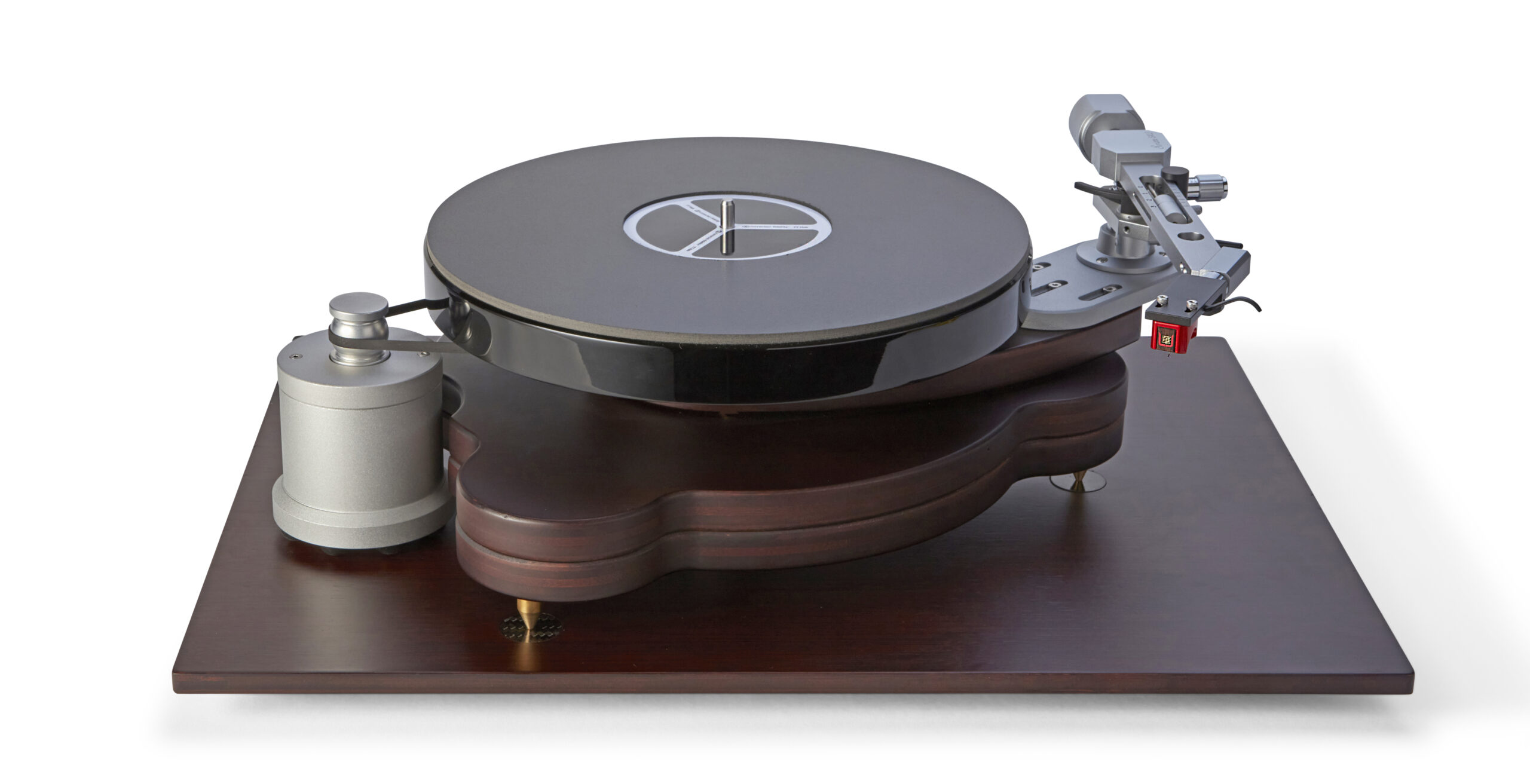
From the first time I saw the TT Hub turntable from Connected-Fidelity, I loved its looks and the quality of its finish. Now I have had one at home, those initial impressions were only confirmed.
Although setting up the TT Hub is not complicated, I was grateful when designer and Connected-Fidelity owner Michael Osborn volunteered to deliver it personally and run me through its finer points.
You may have bumped into him at shows on the Air Audio stand, under which banner he also imports Hana cartridges and Sorane tonearms from Japan. He started Air Audio in 2003 and Connected-Fidelity is its manufacturing arm, producing such products as mains and interconnect cables, mains distribution boxes and balanced supplies, RF filters and isolation accessories. He has 30 years experience in audio design and manufacture.
The TT Hub is Connected-Fidelity’s first turntable. It was supplied fitted with a Sorane SA1.2 tonearm. The TT Hub itself sells for £4,995 and if you buy the package with the Sorane SA1.2, that brings the total to a tad under £6,900. A Connected-Fidelity tonearm cable is also available and was included.
Three tiers
The turntable is a three-tier design comprising a base plinth, chassis and sub-chassis, all of which are machined from bamboo plywood, which look rather elegant in their dark brown lacquer finish, a natural finish is also available. Bamboo plywood was chosen (Bamboo is actually a grass, but plygrass is not in the dictionary!), Osborn explained, because it is immensely strong and has little potential to store energy and resonances.
The tonearm and main bearing/spindle/platter are rigidly connected to the subchassis, which bolts to the larger chassis below, but with solid spacers. The subchassis in turn sits on three pointed brass feet, locating on composite carbon/rubber dampers in the bamboo ply base board to further isolate it from any structure-borne vibration.
The 12-pole AC motor is housed in an isolating pod that sits on rubber feet and is free to move. The user manual says that it should be placed with 15mm clearance between it and the cutout in the subchassis using the spacer provided.
Bearing down
The turntable main bearing is a long and large-diameter, self-lubricating sintered bronze design that uses a PEEK (polyetheretherketone – a high-performance engineered polymer) base component on which sits a sapphire thrust bearing, all housed in a thick-wall aluminium housing.
The aluminium arm mounting plate bolts to the subchassis and can be supplied either blank, or precut for Sorane, Rega or SME arms. Blank units can be cut out to order for any specific arm that the customer requires.
Connected-Fidelity believes that this style of non-suspended turntable design offers “the most lifelike musicality, particularly dynamics, speed and ‘timing’.” I have quite a bouncy floor and can attest that isolation from footfall was excellent.
The power supply for the motor is housed in a separate unit. This quartz regenerator unit is said to offer speed accuracy at 33rpm or 45rpm of 0.003% to compensate for fluctuations in mains frequency, which Connected-Fidelity says can vary by up to 2% moment to moment.
On the front of the power supply box, the LED light glows red/orange when the factory speed setting is used. The rotary control on the left selects 33rpm, 45rpm or off, while the one on the right offers fine speed control if necessary and for those wishing to do so, they recommend using a quartz-controlled battery-operated strobe such as the KSB SpeedStrobe. If you do decide to tinker with the fine adjustment and get lost, pushing the right-hand knob and holding it in for five seconds will reset the factory default.
The high-gloss black acrylic platter of the TT Hub is 30mm thick and has a ‘foamed’ mat bonded to the top of it. This is intended to absorb any vibrational energy from the LP as it plays and isolate the LP from the acrylic platter material.
Disarmingly simple
The Sorane arm is made by IT Industry in Japan, which was founded by Katsuaki Ishiyama in 1974. Priding themselves on precision machining and hand assembly, they have three ranges – the SA1.2, a more conventional looking TA-1 range and a girder-style 12in called the ZA-1.
Ishiyama believes that low-mass tonearms are a poor match for moving coils, and so his arms provide what he sees as the necessary mass for medium- and low-compliance cartridges. The company also boasts very high-quality bearings as it says this has a major influence on performance.
IT Industry says that the bearings used for horizontal movement are axial-loaded thrust bearings with zero play that are held in contact by gravity and act like a unipivot, but with more than one contact point with tapered seats. The main arm component is machined from one billet of aluminium.
The design is easy to use and, unusually these days, has a detachable headshell, making cartridge fitting a doddle. The counterweight slides back and forth to balance the chosen cartridge and there is a captive, sliding weight on a slider within the main arm section that adjusts the tracking force. Bias is set by a rotary control just behind the lift/lower device handle. All in all, I found it easy to use and smooth in its operation.
Sound quality
Fancy claims are all very well, but what does it sound like? To put the TT Hub/Sorane SA1.2 through its paces I hooked it up to an Avid Accent integrated amplifier and a pair of Russell K Red 120Se floorstanding speakers, connected with QED Supremus Zr speaker cable. The unit was supplied with a Hana Umami Red cartridge, which sounded rather gorgeous. However, to facilitate a comparison with a well-respected rival turntable of similar price as a performance benchmark, I fitted it with a Goldring Eroica low output moving coil.
First on the TT Hub’s platter was George Benson’s 20/20 album and the track ‘No One Emotion’. From the first few bars, I could tell I was going to like this turntable. Its sound was pacey, tight, clean, dynamic and detailed. This track has a synth bass line that really pumps it along and it really flew on the TT Hub, whereas on the other benchmark deck the sound was slower, a little turgid and just didn’t move. Benson’s vocals on the TT Hub were open and articulate, with the various layers of this lush and vibrant arrangement well conveyed. The stunning guitar solo from Michael Sembello also had much more bite on the TT Hub and it really soared without being OTT.
The Carlton switch
Switching to my favourite album from Larry Carlton, I wanted to hear what it could do on a well-recorded acoustic guitar. On ‘A Place for Skipper’, the TT Hub acquitted itself well, conveying the presence and bite of his play and revealing how each note was shaped. Soundstage was also more open and defined than on my comparison deck, while the bass guitar line was tighter and more tuneful, with drums and percussion more detailed and dynamic.
I wondered if a rather less well recorded and quirky track might catch the TT Hub out, so I reached for a recent purchase – Messy from Olivia Dean, and the track ‘Dive’, which I just can’t get out of my head. Here, the TT Hub was far from caught out and proved much more open and focused than the rival deck, while the more subtle layers of instrumentation were easier to pick out and follow. The bass line was rather overblown on the other deck, but on the TT Hub it was well controlled, all of which helped to convey the distinctive rhythmic flow of the track.
For a real rollercoaster ride of virtuosity, I spun up ‘Roller Jubilee’ from guitarist Al di Meola’s Splendido Hotel album. Straight away it was clear that his guitar was open and articulate with great bite and inner detail, while drums and percussion were explosive and dynamic. The complex layers of this arrangement were easier to listen into on the TT Hub, while the celeste had more leading edge note detail and the marimba really rang out. The blisteringly fast tempo of the track was also well handled by the TT Hub. Its competitor by comparison seemed slower and rather unexciting, with the track lacking the bite I associate with it.
Hubba, Hubba!
Beautifully made and superbly finished, the Connected-Fidelity TT Hub turntable and its Sorane SA1.2 arm were a joy to use and to listen to. Its sound was detailed, offering good insights into the various layers of the music and how instruments are played and how the musicians work together to create a cohesive and compelling musical experience. It is dynamic, fast and pacey and had my foot tapping in all the right places.
I have no hesitation in recommending the TT Hub/Sorane and it offers excellent performance and value for the asking price. Make sure it’s on your shortlist if you’re in the market for something at this price.
Technical specifications
- Type: Belt-driven turntable with AC synchronous motor, controlled by and remote quartz controlled microprocessor PSU.
- PSU speed accuracy: 0.003%
- Speeds: 33.333rpm and 45rpm, electronically selectable
- Chassis: Bamboo plywood
- Platter: Acrylic with integral foamed platter mat.
- Tonearm: Sorane SA1.2 9in K2 arm with miniature radial bearings
- Arm lead: Connected-Fidelity DIN/RCA-U-1.00E
- Dimensions (HxWxD): 85mm x 540mm x 390mm
- Weight: 14.5kg
- Price: £4,995; £6,890 with Sorane SA1.2;
- Above plus Connected-Fidelity tonearm lead £7,675
Manufacturer
Connected-Fidelity
UK distributor
Air Audio Services Ltd.
+44(0)1491 629629
Trending Articles
See all
By Chris Frankland
More articles from this author


Read Next From Review
See all
D’Agostino Audio Pendulum
- Jul 14, 2026
Meze Audio 105 AER
- Jul 14, 2026
REL T/9x SE
- Jul 14, 2026
Pro-Ject Speaker Box 5 E Carbon
- Jul 14, 2026