


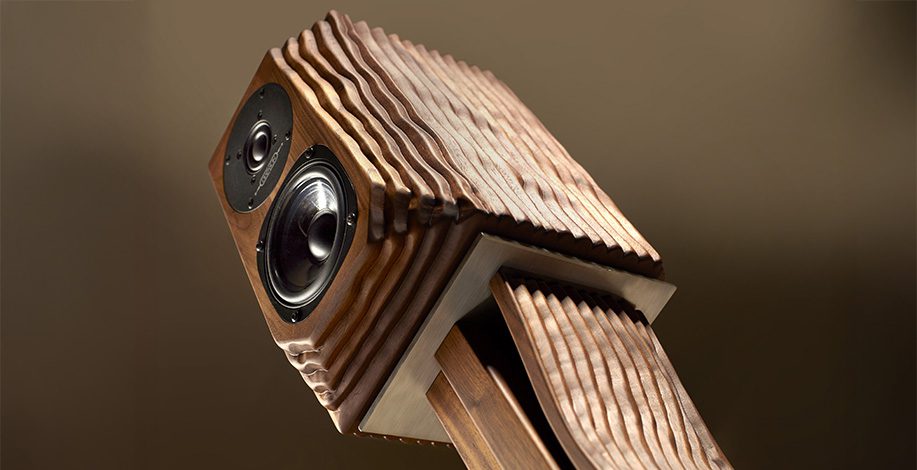
I’ve never had a pair of speakers at home with a human vocal reproduction realism of the Diapason Karis Wave.
I love small, stand-mount, speakers. In typical small to medium rooms here in the UK, they eliminate many problems. The key problem of small rooms is too much bass over-driving the room, meaning you hear more of the room than the speaker. A small speaker’s bass is limited, so you will hear more of the speaker. This makes room optimisation via speaker position easier, not least because they are easy to move. While they may lack the deepest bass, their output is easier to control and tune, resulting in better bass definition. I was excited to receive the Karis Wave for review. To my surprise, so was my wife. Because of their unique crafted design, we had domestic bliss! Nice start.
1 of 200 Waves
The Diapason Karis Wave are produced in a limited run of 200. I don’t know of any other hand carved speakers (from aged Canaletto walnut staves), inside and out, front and back, with waves. A partnership formed between Antonio Comini (the “artist”) and Alessandro Schiavi (the “designer”) draws on Antonio’s knowledge and expertise gained from making violins in the Italian city of Brescia, that has a violin making school dating back to the 14th century. Every cabinet is unique. Unlike most other speaker cabinets that aim to be as inert as possible, they are honed to work with vibrations – harmonics in music. The only other speaker I can recall with that ethos are the Kiso Acoustics HB-1. The maker of those used expertise gained from guitar making.
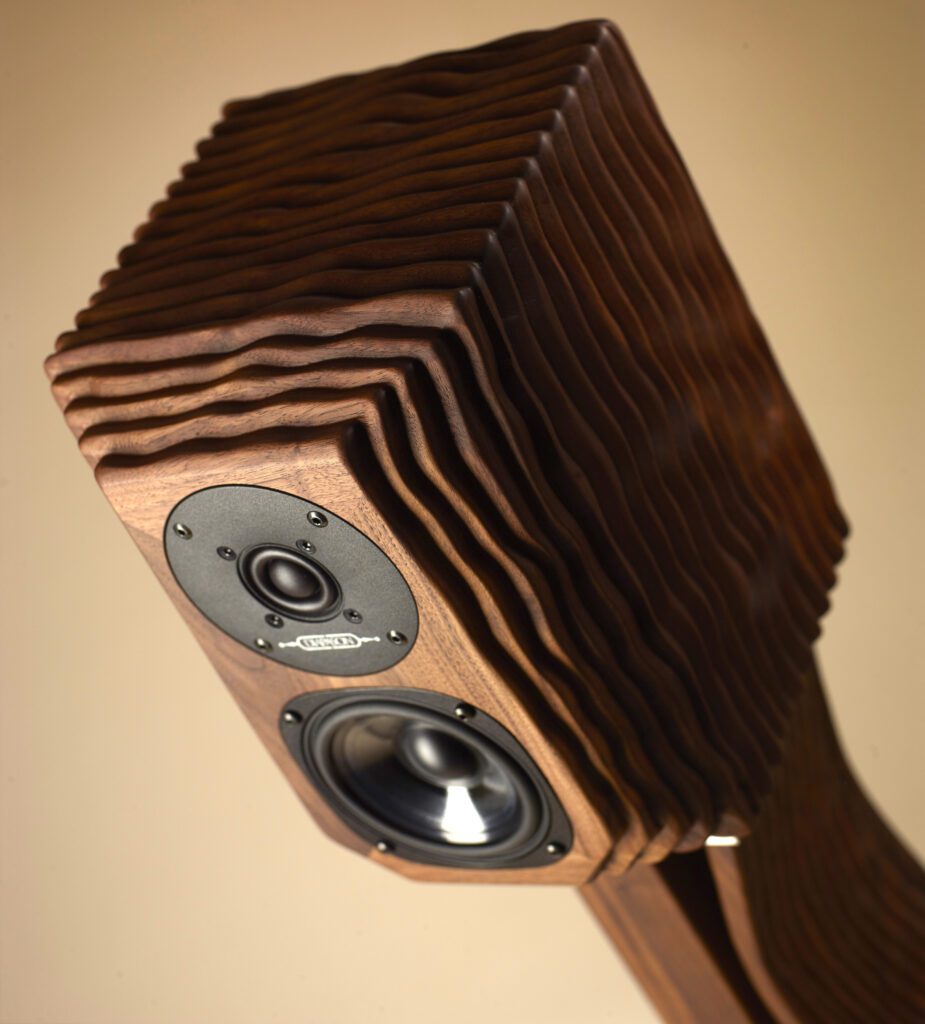
Electrically, the Karis Wave have ‘Diapason Direct Drive’ meaning the 11cm Diapason specified SEAS bass unit is directly connected to the amplifier. There are no cross over components in that path meaning it sees the full frequency range of my David Berning QZ amplifiers. Only the 19mm SEAS tweeter has crossover circuitry albeit with just three components elegantly arranged directly behind the rear circular connection plate. All internal wiring is Van den Hul SCS-12. Connections are bespoke Diapason, that accept banana and spade termination.
Set up is king
Diapason produces matching speaker stands that mimic the wave design complimented with stainless steel. I didn’t have those to hand so I used my Raidho stands that gave the perfect height, and I must say, excellent performance.
Important: when you put new speakers in the system it’s likely you’ll have to make changes downstream to extract optimum performance. My changes were…
1: The biggest and most fundamental change was speaker positioning. The frequency response of the Karis Wave is specified as 60Hz to 20kHz which suggests not much low bass. My usual speaker position is over 1.5m from the wall. I tried that but I found that voices could sound a little like they were coming from cupped hands. And as you would imagine, bass weight was low.
So, I gradually moved the Karis Waves closer to the wall, settling at 40cm. Before listening, I knew the bass would increase but at the same time I worried I would lose the detail and intimacy of being further out in the room. My worries were unnecessary. The fine and atmospheric details produced by the Karis Wave, creating a believable soundstage, were not compromised if anything they were improved. In fact, I ended up with superb balance. Further fine-tuning led to moving them wider apart with a slight toe-in resulting in an impressive sound stage with vocals right in front of me.
2: My David Berning QZ amplifiers have the option to control feedback, which affects the damping control of the speaker cone. I changed from “normal” to “low” and I found the sound really opened out, became more natural, and removed any sense of fatigue. This suggests that the Karis Wave would work well with amplifiers with low damping factors such as valve amplifiers.
3: Reducing the output voltage from my dCS Rossini Apex from 6V to a more standard 2V. This was necessary because the Karis Wave is of higher efficiency compared to my regular Raidho D1.1 speakers. This had me rushing to the Pre-Amp to turn the volume down – too much gain at lower settings. Talking to Gary Campbell (distributor) he said that makes sense because the impedance curve of the Karis Wave is near flat making them easy to drive.
Wall of sound
With acoustic and naturally recorded vocals, the low bass is just not a concern. I found myself listening to a huge wall of sound in my small/medium room. It got me thinking I could imagine these working impressively well in a much bigger room.
Balance and proportion
I was keen to listen to the track “Fields Of Gold”, a version of the Sting song by Fourplay from the album Journey [Bluebird]. It has a prominent bass guitar that feels essential to the foundation of the piece adding flow and direction. It highlighted the Karis Wave have a wonderful balance and proportion of the sound spectrum. Yes, the deepest, occasional, bass quantity was not there, but bass quality was, so in terms of enjoyment, I didn’t not feel I was missing out. It is a different balance in terms of “sound quality”, but the way the Karis Wave musically integrates everything, results in something greater, bigger, than the sum of its on-paper specification suggest. It can be a staggering and addictive experience.

Moving to “The Golden Age” by Beck from the album Sea Change [Geffen Records], it occurred to me, in terms of music arrangement, the sense that everything is in the right place at the right time had never been clearer. How do I know what the artists intended? I haven’t got a clue, none of us have, but boy did it feel right.
Down to the River
An all-time favourite album of which I never tire is River: The Joni Letters by Herbie Hancock [Verve Records]. Listening to the track “Solitude” made me appreciate the perfect integration (time and phase) between the drive units. A goal of the shape and size was to get as close as possible to a point source; Job Done! Music sounded wonderfully real because at no point did the Karis Wave get flustered by any musical complexities or conflicts. Sticking with the same track highlighted another physics advantage of small speaker units; their low inertia – the stopping and starting of the drive units – coupled to cabinet design.
I heard that in terms of absolute clarity in the placement of instruments impressively projected into the room. The Karis Wave deliver sharp leading edges that further perfectly place instruments in the room, followed by a faithful decay complimented with perfect hand over to the next note. If ever I could hear Herbie Hancock’s wonderfully light and considered touch of the keyboard, it was now. I could not find any piece of music that got the Karis Wave flustered or sounding dull or compressed. However, do bear in mind the quality of the system downstream, meaning the Karis Wave is totally at home with high resolution, high-end systems.
Vocals
Lyrics take no effort to understand. I know exactly what is being said, how and the intent. It’s like listening to great headphones but with all the advantages of speakers. Listen to “My Father’s Voice” by Judith Owen from the album The Beautiful Damage Collection [Courgette Records] on the Karis Wave and you will cry. She will be physically and emotionally uncomfortably (in a good way) close to your face. You’ll see and hear every movement of her lips and resonance of her vocal cords. However, it won’t be in a clinical hi-fi ultra clear way, which would sound impressive for 15 minutes, but fatiguing thereafter. Don’t get me wrong it’ll be the clearest, smoothest you’ve likely heard but with a quality of musical involvement that will draw you in and hold you. You’ll further appreciate no trace of sibilance whatsoever.
Domestic bliss
The Karis Wave is wonderfully more crafted than engineered. Diapason’s holistic care and attention points to what could be, for some people, an endgame speaker. Unless you are a headbanger, you might find it hard to find a better real-life speaker loved by all. If you do, you’ll be spending two to three times more. My wife would say BUY NOW! I’d agree.
Technical specifications
- Type: Rear-ported reflex two-way standmount loudspeaker
- Drivers: 19mm Sonomex soft dome tweeter with wide surround, 110 Diapason Direct Drive mid-woofer with polymetilpentene cone
- Frequency Response: 60Hz-20kHz
- Sensitivity: 87dB/W/m
- Nominal Impedance: 8Ω (7.2Ω minimum at 300Hz)
- Crossover Frequency: 3kHz
- Finish: Canaletto walnut solid wood
- Dimensions (WxHxD): 19x26x28.5cm
- Weight: 4.5kg
- Price: £8,995, $12,500, €11,205 per pair
Manufacturer
Diapason
UK distributor
RAD UK
+44(0)2895 575090
Trending Articles
See all
By Paul Soor
More articles from this author


Read Next From Review
See all
D’Agostino Audio Pendulum
- Jul 14, 2026
Meze Audio 105 AER
- Jul 14, 2026
REL T/9x SE
- Jul 14, 2026
Pro-Ject Speaker Box 5 E Carbon
- Jul 14, 2026