


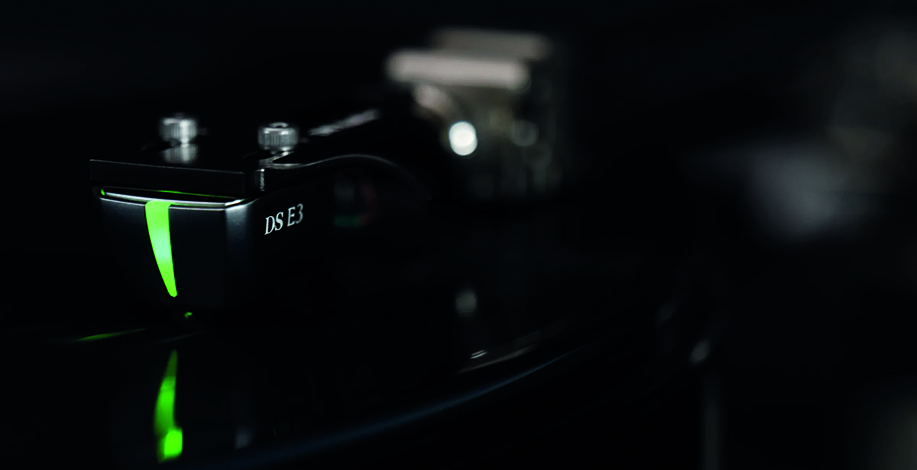
DS Audio’s range of optical cartridges has long intrigued me. So, when they updated and upgraded their entry-level model, the DS Audio DS-E3, I could not pass up the opportunity to review it.
Introduced this summer, the new ‘third generation’ DS-E3 replaces the old DS-E1, costing £2,295 for the cartridge and equaliser package. You need an equaliser to ‘decode’ the unique output of the cartridge. The cartridge does not generate a signal using a conventional moving coil or magnet. Instead, it has a purely optical system of LEDs and photodetectors. The equaliser also provides power to those LEDs.
The nitty gritty
Before delving into the details of how the system works, it is worthwhile to examine its origins. DS Audio, part of Digital Stream Corporation (DSC) in Japan, was founded in 2013 by the then 27-year-old Tetsuaki (‘Aki’) Aoyagi. Aoyagi heard the quality of vinyl firsthand while listening to a friend’s system that included a Toshiba optical cartridge. He even disassembled one! Aoyagi was confident he could improve it using modern materials and technology. The Toshiba cartridge pre-dated the introduction of LEDs and used a filament lamp and phototransistor. This caused a problem with heat build-up.
Aoyagi could draw on DSC’s considerable knowledge and experience. DSC invented the optical mouse with Microsoft. It also has a 25-year track record in laser optics for medical testing systems and laser-based optical instrumentation. He also tracked down and recruited the original designer of the Toshiba optical cartridge.
The company now manufactures six optical cartridges, ranging from the DS Audio DS-E3 to the flagship Grand Master EX. This last features a one-piece diamond cantilever and stylus. It’s priced at £18,995 or £55,000 with the Grand Master equaliser.
Step into the light
So, how does this tiny package of hi-tech wizardry work? Well, you need to throw out everything you know about cartridges. Sure, it has a stylus attached to a cantilever in the conventional way. And, yes, this traces the record groove as you’d expect. But that’s where the similarities end. So, strap in and bear with me…

A DS Audio optical cartridge features no coils or magnets, instead utilising two infrared LED lights and two photo sensors, one per channel. Attached to the end of the cantilever is what they call a shading plate made from beryllium. As the stylus traces the record groove, the shading plate moves in front of the LEDs, causing changes in the light reaching the photodetectors. The photocells detect these changes in brightness, which alter the output voltage. The angular movement of the shading plate ensures that each photodetector can only pick up information from its corresponding channel. DS Audio points out that the output of the photocells is purely analogue, not digital.
Advantages
You might think it’s very clever, but why bother? DS Audio claims that the optical system has some significant advantages. For one, the moving mass is significantly lower, with the beryllium shading plate weighing just 0.74 mg, which they claim is approximately one-tenth the mass of a conventional magnet or coil assembly. This, allied to eliminating any magnetic damping effect of a coil/magnet system, is said to leave the cantilever/stylus assembly freer to follow the modulations of the groove.
DS Audio also claims that the optical system eliminates the non-linearities and distortions in an MM or MC generator system caused by a phenomenon called hysteresis, which is the lagging of the magnetisation of a ferromagnetic material, such as iron, behind variations of the magnetising field.
Although the output from an optical cartridge requires a dedicated equaliser, DS Audio says the output requires less manipulation than traditional moving coils or moving magnets, as it is flat across the entire frequency range. This means the circuitry can be kept simple. The DS-E3 equaliser uses an op-amp to minimise the number of components in the signal path and keep the unit small. It connects to a line input on your amplifier.
Third generation
As mentioned above, the new ‘third generation’ DS-E3 entry-level replaces the old DS-E1 introduced in 2019. However, the E3 also draws on technology developed for the flagship model.

It features two independent LEDs and photodetectors for the left and right channels, whereas the previous model had just one. This, it states, has dramatically improved channel separation by as much as 10 dB at high frequencies. It is also said to have eliminated crosstalk, increased the cartridge’s output from around 50mV to 70mV, and significantly improved the signal-to-noise ratio.
The DS-E3 features a reshaped shading plate, now made from beryllium rather than aluminium, which reduces its weight by more than 50% from 1.56mg to 0.74mg. DS Audio claims this is one-tenth the mass of a typical core and coil system in a moving coil cartridge. The cartridge’s internal wiring is also 1.6 times thicker to reduce impedance.
The cartridges and equalisers are hand-made by DS Audio in their factory in Sagamihara. Ogra and Namiki make the cantilevers and styli.
Proof of the pudding
Now you know how this optical cartridge works and why DS Audio believes it is an improvement over conventional design. But you and I want to know what it sounds like. My local retailer had often waxed lyrical to me about DS Audio’s optical cartridges, so I was particularly excited to try one myself, finally. So here goes…
I mounted the DS-E3 in a Tracer arm on a Clearaudio Innovation Compact turntable, playing through my Audio Note Meishu Tonmeister integrated valve amp and Russell K Red 120Se speakers.
The Clearaudio turntable also allows two arms to be fitted. I procured a second Tracer into which I mounted a well-respected moving coil. The Tracer’s price, including a phono stage, was similar to that of the DS-E3 and its equaliser.
The first track I played was the fast-paced ‘No One Emotion’ from George Benson’s brilliant 20/20 album. What struck me straight away about the DS-E3 was its life, pace and openness. Benson’s vocals were packed with emotion and pleasingly accurate, while the driving synth bass line was tight and moved this track along. It also allowed you to listen to the various layers of this lavish production. The moving coil cartridge sounded mellower, more laid-back, less insightful on drums and percussion, and lacked the sheer verve and excitement of the DS Audio DS-E3.
Impressive openness
Moving on to a masterful jazz singer/songwriter/piano player I have seen many times in concert, I played ‘It Didn’t All Come True’ from Ben Sidran’s superb Bop City album. The DS-E3 impressed me with its openness to Sidran’s vocals, allowing me to listen to his fleet-fingered piano play. His piano sounded open and dynamic, while the drums had a real kick and presence, and more subtle cymbal detail was well separated. When the track’s tempo picked up with the bass line moving it along, the DS-E3 was no slouch. The conventional MC cartridge was suitable, but it lacked the detail and energy of the DS Audio.

The DS-E3 also proved its worth with a superb rendition of ‘Red Lights in the Rain’ from Stephen Fearing’s The Secret of Climbing album, conveying the nuances of his vocal delivery and the skill in his guitar play. On ‘Human Nature’ from Miles Davis’s You’re Under Arrest, the DS-E3 captured his enigmatic style and sublimely understated phrasing with more allure and impact than its MC rival. It allowed me to hear more about what makes Miles unique.
Recordings from the Seventies vary tremendously in quality, but Hasten Down the Wind by Linda Ronstadt is superb. On ‘Lo Siento Mi Vida’, the DS-E3 conveyed her vocals’ nuances and power without making her sound like she was shouting. The drums and the percussion were also compellingly detailed and punchy, and the track had a more emotional impact and inner detail than its MC rival.
The light fantastic
This first acquaintance with DS Audio’s optical cartridge technology has whetted my appetite. Suppose this model is anything to go by. In that case, the optical cartridge offers a more open, dynamic, pacey and detailed sound, delivering excitement and energy while capturing subtle nuances in the mix and individual musicians’ contributions.
The DS Audio DS-E3 gave a superb performance, and I highly recommend it.
Technical specifications
Cartridge
- Type: Optical pickup cartridge with dedicated equaliser
- Body material: Aluminium
- Cantilever material: Aluminium
- Stylus: Elliptical
- Output: >70mV
- Channel separation: >26dB (at 1kHz)
- Tracking force: 2.0 – 2.2g (2.1g recommended)
- Weight: 7.7g
Equaliser
- Input: RCA
- Outputs: 2 x RCA
- Output 2 has a subsonic filter (20Hz, -6dB/oct)
- Impedance: 120 ohms
- Pre-amp input impedance: >10k ohms
- Dimensions (HxWxD): 260mm x 69mm x 195mm
- Weight: 1.86kg
- Price: £1,270, $1,375, €1,495. Equaliser £1,270, $1,375, €1,495. Package price: £2,295, $2,750, €2,990
Manufacturer
Digital Stream Corporation
UK distributor
Sound Fowndations
+44(0)118 981 4238
Trending Articles
See all
By Chris Frankland
More articles from this author

Read Next From Review
See all
D’Agostino Audio Pendulum
- Jul 14, 2026
Meze Audio 105 AER
- Jul 14, 2026
REL T/9x SE
- Jul 14, 2026
Pro-Ject Speaker Box 5 E Carbon
- Jul 14, 2026