



Rockna’s outstanding Wavedream DAC is now a decade old. It pushed the limits of what could be extracted from a digital signal at its price and beyond. However, technology has progressed. The new Wavedream Reference Signature DAC is the result. It’s a DAC that stands toe-to-toe with the best. Do not assume this ‘Reference’ DAC is just a ‘tarted up’ version of the original. This is the outcome of years of research and development on Rockna’s part. The result is a new product and a complete brand transformation. So, no big deal, then!
However, Rockna, old and new, remains dedicated to doing everything correctly. Rockna shuns the ordinary and opts for proprietary hardware and custom software throughout. No off-the-shelf solutions, such as DAC chips, OEM streaming modules, or signal op-amps, are used here. Instead, it continues to uphold its core ethos of creating original products that look appealing on the outside and feature elegant technical solutions beneath the surface.
Not a crank
Audiophiles spend considerable time discussing the brand and model of DAC chips within our converters. We liken them to the ‘engine’ of digital audio, though ‘crankshaft’ or even ‘flywheel’ might be more fitting. The other elements of the digital audio circuit, such as sample rate conversion, clock accuracy, filtration, and the nature of the conversion algorithm, are all more significant than who ‘fabbed’ the silicon.
Rockna’s ‘chip’ is an evolution of the DAC modules in the original Wavedream DAC. The modules remain a discrete sign-magnitude hybrid ladder array driven by an algorithm embedded into their FPGA (field-programmable gate array). They can sustain rates up to 6 MHz, and the output of the DAC modules is unbuffered.
Although the digital ‘architecture’ resembles the Wavedream, the ‘town planning’ (circuit layout) differs significantly. The Reference Signature features a 10-layer central core board for the digital front-end processing and the network renderer. It also features a new dedicated low-noise power supply board and new conversion boards in a symmetrical configuration, two for each channel. To preserve and maintain signal integrity, the clock and data signal paths were shortened and featured higher-quality board-to-board connectors.
Linear supply
Unlike many DAC designs, the Rockna Wavedream Reference Signature features linear power supplies primarily. There are always pre-regulator stages, and each stage has additional local regulation. Twenty power integrated circuits drive roughly 90,000µF of capacitance.. The audio-grade toroid transformers are concealed beneath a thick copper sheet that serves as a shield. A similar copper cage also shields the display.
An AMD ZynQ MPSoC (Multi-Processor System on Chip) handles general processing, running under a custom Linux kernel. This is a planet-sized sledgehammer to crack a nut; the ZynQ has more than enough processing power to cope with even the toughest audio operations. Nothing we can put in its path will trouble this circuit.

The last stage of the signal path is the analogue output stage. Designed from scratch to work with the new conversion modules, it is discrete and acts as a high-speed buffer. Combining JFET and bipolar devices into a class A design, the Wavedream Reference Signature’s output stage features a low closed-loop output impedance and equivalent input noise as low as 1nV/√Hz.
Sample conversion
Arguably, the most significant difference Rockna has over most of its rivals is its removal of any ASRC, or asynchronous sample-rate converter. When moving the audio information from the digital to the analogue domain, the clock system plays a critical role in giving the sound a sense of realism and dimensionality. Most DACs take the easy route by relying on the ASRC built into their chipset. While the ASRC may have a distinctive signature, the quality of the ASRC implemented in DAC chips is influenced more by cost and silicon real estate than by outright performance. Instead, the Wavedream Reference Signature uses an advanced, ASRC-free digital PLL clock solution.
The Wavedream upsamples any material at a fixed rate of 16x. The DAC modules decode the digital stream at either 768 kHz or 705.6 kHz, depending on the input sample rate. Rockna claims this rate is optimal for the analogue performance of the DAC modules.
Processing power
Upsampling is closely linked with the filter options and relies heavily on processing power to perform effectively. Rockna opted against standard Nyquist-Shannon filters, believing they do not deliver the desired performance for the DAC. Instead, after conducting extensive mathematical simulations and meticulous listening tests, Rockna developed a custom Parks-McClellan upsampling filter with variations for linear, minimum-phase, and hybrid-phase responses. In the linear phase, the ringing energy (Gibbs’ overshoot) is evenly distributed before and after the impulse. The minimum phase type displays all this energy following the impulse. In contrast, the hybrid phase filter presents a combined response between linear and minimum, showing very low overshoot before the impulse. There are also selectable dither and DSD bandwidth settings.
We’ve concentrated on the internal layout, but the styling has been gently revised, moving forward while echoing the previous models so they won’t look out of place on the same rack. At the centre of the front panel is an 800×480 pixel, 3.5” touch panel, and there is a control app (for set-up rather than day-to-day operation). The rear includes low-impedance XLR and RCA outputs.
This is more than just a DAC. The Wavedream Reference Signature features a network renderer that seamlessly integrates into the DAC’s digital front end. There is no separate ‘streamer section’ on board, as it’s part of the software built into the FPGA. This removes the need for a dedicated external connection and unnecessary obstacles in the digital signal path. There is even a 32-bit volume control that operates in 0.5dB steps; while most will choose a preamp to take on that task, it’s not a bad option, even at low listening levels.
Job well done
There’s a lot of technology here, and I’m not sure which part contributes to the Rockna Wavedream Reference Signature’s outstanding sound quality, but whatever it is, it does the job correctly. It also didn’t matter how the track reached the Rockna, whether on a spinning disc, in a local store, or online; it delivered a good performance regardless.
I started the listening with ‘Paradis Perdu’ by Christine and the Queens [Chaleur humaine, Because]. His voice is played extremely naturally, with excellent vocal articulation. It’s always helpful to not use your native language here, as your brain doesn’t fill in the lost diction or increased spitchiness, and as I’ve been known to order a fried orange in suitcase sauce in France, this is a great track. It’s also extremely well produced with excellent separation between instruments, which is brought out perfectly with the Wavedream Reference Signature.
More significantly, there’s a sense of ordered refinement to the sound, regardless of what you play. And by that, I mean ‘jazz covers of AC/DC songs’ [Jens Thomas, Speed of Grace, ACT] and ‘Hollow (16 Bit Remix)’ by Björk [Bastards, One Little Independent] and ‘Glory Box’ [John Martyn, The Church With One Bell, Independiente]. Each delivered a sound far less like ‘digital’ (with no glare or top-end detail), but not like a faked vinyl version. If anything, they sounded like really well-produced open-reel tape, but not one that had been played to pieces.
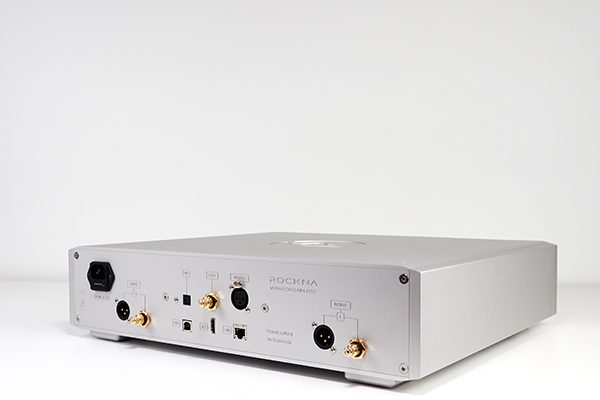
Part of the reason it sounds less digital than usual is the lithe and legato nature of the performance. In the wrong hands, this could sound saccharine and overly polished, but the Rockna treads a careful line between sounding refined and elegant and overly refined and ornate.
Musical Rodeo
Of this flurry of tracks, the Björk is particularly telling. This is more like a musical rodeo than the kind of track you’ll want to sit down and listen to. Interesting, gut-rumbling noises aside in the introduction, when the broken beats and her singing kick in, the sound is pretty forward and can pitch into brightness. It’s never a ‘pretty’ sound, but the Rockna’s ability to process music with refinement and grace makes it more listenable. You can listen to the whole track without wincing, and that’s impressive. Replace ‘Björk’ with ‘harpsichord’ (it’s an easy mistake to make), and the same holds; the plucked sound can be grating on the wrong system, while others overcompensate and make the sound too legato. Here, it was just right.
Digital audio has a punctuated equilibrium. Nothing really changes, with only minor differences in performance over the years. Then, there are significant leaps in performance over the course of a couple of years. This is one of those times. The Rockna Wavedream Reference Signature DAC is a perfect example of just how good digital is today. It joins that select handful of products where you can find ‘different’ in digital, but not ‘better’, no matter the price.
Technical specifications
- Type: R2R based DAC/Network Audio Processor
- Inputs: LAN, USB, I2S on HDMI, AES/EBU on XLR, S/PDIF coaxial and Toslink
- Outputs: RCA and XLR
- Audio Renderer support: Roon bridge, UPnP, OpenHome, AirPlay, HQPNAA, Spotify Connect
- Standards supported: PCM to 705.6/768kHz, DSD to DSD512
- THD: -102dB (-3dB)
- DNR: 139dB
- Finish: Matt black, matt silver
- Dimensions (WxHxD): 45 x 39 x 10.5 cm
- Weight: 10kg
- Price: £23,999, $26,600, €26,600
Manufacturer
Rockna Audio
UK distributor
Audiofreaks
+44(0)208 948 4153
Trending Articles
See all
By Alan Sircom
More articles from this author


Read Next From Review
See all
D’Agostino Audio Pendulum
- Jul 14, 2026

Meze Audio 105 AER
- Jul 14, 2026
REL T/9x SE
- Jul 14, 2026

Pro-Ject Speaker Box 5 E Carbon
- Jul 14, 2026