


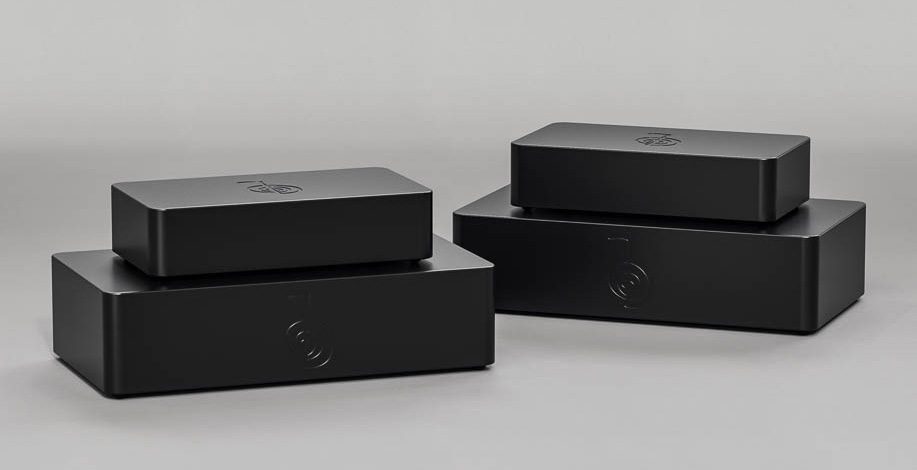
On opening the distinctly plush packaging and extracting these attractively hewn devices, I was a little surprised to find that Reiki Audio’s SuperSwitch does not resemble the examples that other audio manufacturers and the world of networking describe as a ‘switch’. All of the latter have multiple ports. Some, like the Innuos PhoenixNET, have only four. However, the majority stick with the eight found on the commercial switches, which are usually based on. Reiki’s switches have a single input and an equal number of outputs. They function more like a filter, but are in fact network switches under the skin.
It has become apparent that using multiple network switches in a cascaded configuration has positive effects on a streaming audio system. Each one reduces the high-frequency noise that abounds on data networks. That is noise which inevitably infiltrates our streaming devices and makes its way into the audio signal. The best way to improve the sound of a streaming system is to reduce this noise by whatever means possible; some, such as Network Acoustics, do it with a passive filter, while others, including Ansuz, Melco, and English Electric, have taken the switch route.
Eureka
Reiki founder Nigel Bell comes from an IT background and, like many others, doubted the benefit of using a network switch in a streaming system until he tried a cheap example and had an epiphany. He expected to hear nothing or nothing more than a subtle change, but in his words, “it simply wasn’t”. That was in 2019, when he was working on an equipment rack that not only sounded good but also looked good enough to put in a living room, which forced a change of approach and led to the Reiki SuperSwitch.
Nigel’s thinking is that an audio streaming switch does not need multiple ports. In many instances, there is only a streamer in the system, so all it needs is a network feed. So he takes a regular eight-port switch and shields the unused ports to stop EMI/RFI noise from getting into the switch, then removes any indicator lights because of the noise they might create within the circuitry and because RFI gets into the casework via the holes around the lights. Hence, the solid appearance of the Reiki casework.
The Reiki SuperSwitch incorporates copper shielding and an RFI/EMI absorber within the aluminium casing. This reduces noise on the Ethernet connection.
Power Supplies
The SuperSwitch is available with a basic 5V power supply for £1,650, but Reiki also make the Pro 5V linear power supply, which sells for £1,950 on its own or as a bundle at £3,250. The ultimate Reiki package we are considering here is essentially two SuperSwitches, each with its own Pro power supply, which costs £6,350. When this review was published, there were two versions of the SuperSwitch: the ‘Master’ model and the ‘Servant’, which was designed to work at the router end of the system. However, as most people used two Master models, the Servant was dropped… whether people chose two Master models because they felt ‘Servant’ was a bit too ‘Downton Abbey’ for their tastes remains to be seen. Also, when this review was published, Reiki did not offer its own Ethernet cable.
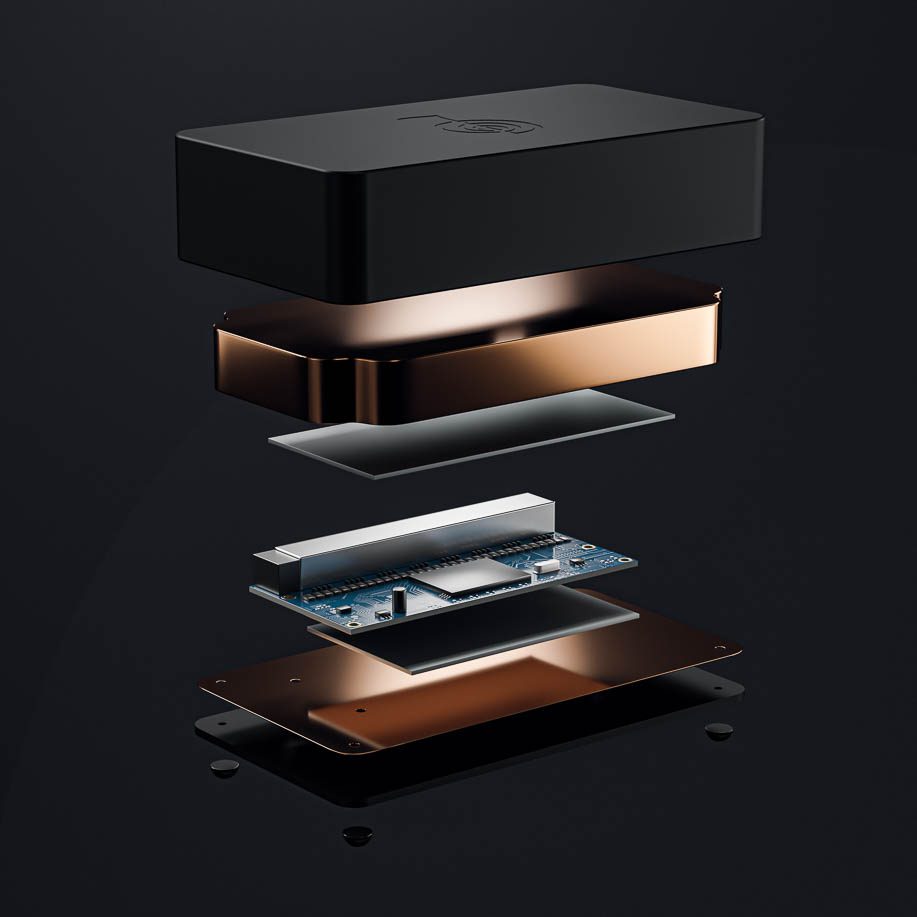
Build quality is high, with 5mm-thick aluminium casework in an anodised black finish. The connection between the Pro power supply and the switch uses a 50cm braided cable that locks onto the PSU. The in/out indicators on the switch are laser cut into the casework next to each port, but it should work either way round.
Just two
The presence of just two connections on the SuperSwitch means that those of us with music servers to include in the network have to use a router output to connect the server, with a second cable going to the SuperSwitch and thence to the streamer. Alternatively, on servers with a player output, you could place the SuperSwitch between it and the streamer, but this would require the server to be on to play Qobuz, Tidal, etc. I started by placing the SuperSwitch in the former arrangement, with both the SuperSwitch and the Melco N10 server connected to an English Electric 8Switch (with Chord GroundARAY onboard), so that the SuperSwitch was close to my Lumin U2 Mini streamer. In this situation, adding the SuperSwitch brought openness, clarity, air and shine to ‘Babylon Sisters’ (Steely Dan). It clearly drops the noise floor, bringing you a step closer to the music.
Profound Change
In a more conventional arrangement without the EE 8Switch and with both streamer and server connected to a Cisco 2960 switch, introducing the SuperSwitch brought about a more profound change with backgrounds becoming notably quieter and the sound being purer, more relaxed and with greater focus on the imaging. The latter took on a distinctly three-dimensional character, and nuances came out in the performance that were not clear without the Master in the network. Adding a second SuperSwitch to this arrangement also proved highly beneficial, with a further increase in image solidity and a tremendous sense of presence; it felt as if the vocalist were in the room. Going back to ‘Babylon Sisters’ revealed that timing too had become clearer and that it was easier to differentiate between the two guitars in the mix.
Introducing the SuperSwitch into a Qobuz stream made Bonnie Raitt’s ‘Too Long at the Fair’ even more beautiful thanks to enhanced dynamics, greater clarity and all-around separation and transparency. Adding another SuperSwitch to this chain brought more intricacy to the sound, greater purity of voice and a better sense of involvement. What it does prove is that cascading switches work and work well. Introducing the EE 8Switch/GroundARAY into the same network had a more darkening and calming effect. It also enhancing timing, which is a classic Chord Co/English Electric characteristic.
Opening Up
Approaching this the other way round, with the 8Switch in circuit and the SuperSwitch added, opened up the sound. This was thanks to a more detailed and better-timed presentation. Adding a second SuperSwitch to this chain increased image width and relaxed the sound. It delivered a different result from that heard earlier. That said, it was similar to adding the 8Switch to the two SuperSwitches. Cascading clearly works.
I also listened to the Reiki switches with an AURALiC ARIES G1 streamer. The Reiki SuperSwitches are very good at unearthing quieter details in almost any piece of music. However, they are especially strong with leading edges. These are picked from instruments even when they are low in the mix. This was apparent on the cymbal in Arab Strap’s ‘Packs of Three’ and made the tempo clearer. Adding just the one SuperSwitch to the link between a Cisco switch and a Melco N5 (USB out to iFi Pro iDSD Signature DAC) had the same effect. It added definition to the leading edges. This produced a tighter, more solid sound, making it easier to hear details like effects on the vocal.
The build and finish on the Reiki SuperSwitches are impressive. I particularly like the way the symbol is laser-cut into the lid. More importantly, they do what it says on the website. They reduce the amount of RF/EMI noise that gets into the audio signal from the network. That, in turn, means a more natural, engaging sound that makes you want to listen louder and for longer. What more can you ask for?
Technical specifications
- Type Streaming audio network switch
- LAN Ethernet ports Two (via RJ45)
- Fibre optic ports none
- Clock 25MHz
- Packet data buffer 128KB
- Features Separate linear power supply
- Finish Anodised black
- Dimensions (H×W×D) SuperSwitch: 45 × 182 × 100mm
Power supply: 68 × 250 × 138mm - Weight SuperSwitch: 890g
Power supply 2.5kg - Price £3,250
Manufacturer
Reiki Audio Ltd
+44(0)7880 500999
Tags: FILTERING NETWORK SWITCH REIKI AUDIO SUPERSWITCH PRO/PRO STATEMENT
Trending Articles
See all
By Jason Kennedy
More articles from this author

Read Next From Review
See all
D’Agostino Audio Pendulum
- Jul 14, 2026

Meze Audio 105 AER
- Jul 14, 2026
REL T/9x SE
- Jul 14, 2026

Pro-Ject Speaker Box 5 E Carbon
- Jul 14, 2026